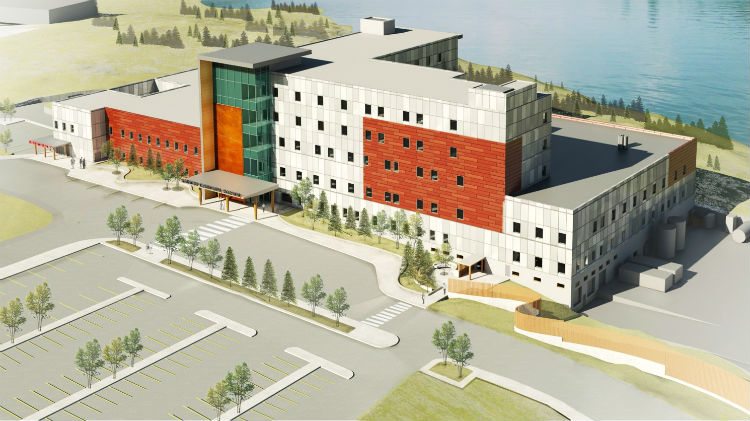
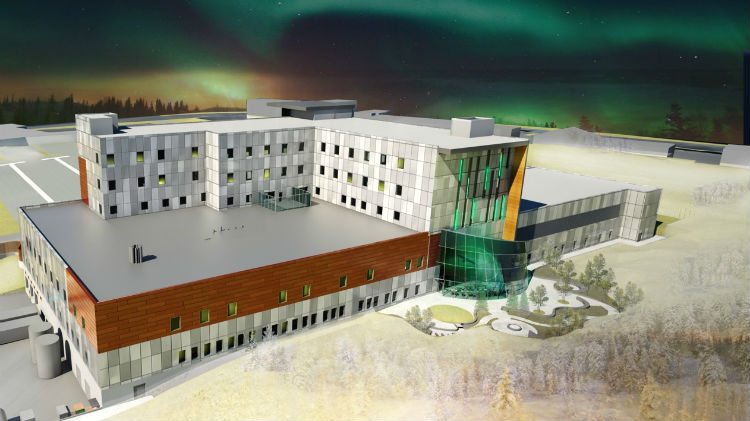
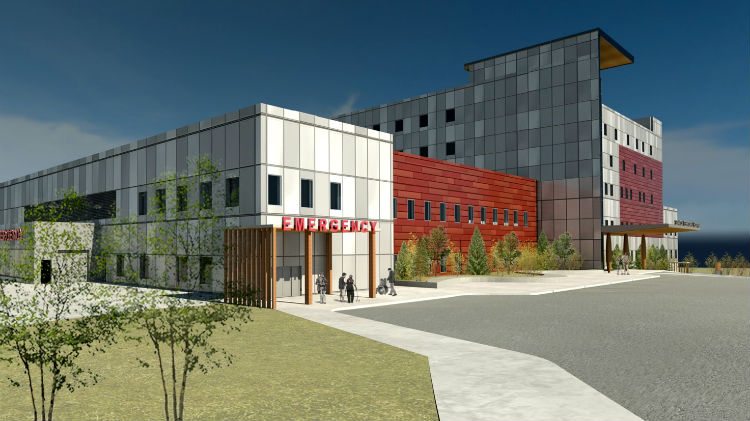
This is the hospital Yellowknife gets in return for $750 million in territorial cash, paid over 34 years.
That’s the deal the territory has signed with Boreal Health Partnership (BHP) to build an all-new facility – ditching the NWT’s old plan to simply renovate the existing Stanton Hospital.
Now, the current Stanton building will be turned into something new by BHP, although it’s not clear what that might be.
The territory believes it might even be able to make some money off that building, and insists $750 million actually represents good business.
“From strictly a financial point of view it provided the most value for money,” said Sandy Kalgutkar, from the Department of Finance.
“The value of the contract is a big number – it’s $750 million over the 34-year agreement. That includes the capital cost the GNWT would be contributing to, plus 30 years’ worth of annual payments to BHP.
“When we did the business case for the project, if the government did it as a traditional design-build and operated the hospital as it does now, we were projecting the cost to be over a billion dollars – so there are some significant savings there.”
Public-private partnerships (or P3s, for short) don’t enjoy the finest of reputations in the NWT, partly through past failures elsewhere in Canada and partly because of problems closer to home.
Here’s a sample of MLAs’ comments on P3s over the past year:
“There are numerous examples where P3 has failed this government.” – Daryl Dolynny.
“This Stanton project is a P3 project. It has the potential to run off the rails and to put us into a greater financial hole than that which we think we are in already.” – Wendy Bisaro.
“So far we don’t have a good record for finishing our large infrastructure projects on budget, most recently of course is the Inuvik-Tuk Highway, which is half built and already 15 percent above the promised cost.” – Bob Bromley.
The territorial government acknowledges that P3s do not have an unblemished track record.
“In terms of the P3 industry and hospitals, in the early days I would have to generally agree that hospitals were not developed particularly well. But the market has matured since then,” Kalgutkar told Moose FM.
“Recent cases have demonstrated they do have value over a traditional build. The government has undertaken some significant due diligence on the project and we have a significant amount of oversight.”
Health minister Glen Abernethy said last week that the territory would institute a “hard cap” of just over $300 million on construction costs for the new hospital, theoretically limiting the cost of building the facility.
“We reviewed other P3s that were done for the construction of hospital facilities across the country and there have been some that have worked out not particularly well,” admitted Abernethy. “But we also know that there have been some that have worked out.”
Kalgutkar says tens of millions of dollars in construction work has been earmarked for northern businesses.
“There is a significant amount of both northern and local content, both for the construction period and on an ongoing basis,” he said,
“The way we monitor that is BHP has to report to the government about those targets on a regular basis. During the construction period, I think they identified about $70 million in local and northern content.”
So why the change in plan? Why a new hospital where previously the government felt renovation would be the way to go?
Kalgutkar says the new build offers more value for money and a larger hospital, with double the footprint and single-inpatient rooms.
“The biggest advantage of a new build is we really avoid the transition – it’s one move,” he said.
“If we were renovating the existing hospital we would have significant infection control protocols. Having a new build reduces that risk.”