Forget what you think you know. The population of the Northwest Territories is increasing.
Statistics Canada, in this week’s latest release of population data, estimates the territory to have a population of 44,088 as of July 1.
This is the largest July figure in the territory’s history – a small but significant increase of 108 on July 2014, which itself boasted an increase of 96 on July 2013.
In fact, not since 2009 has the NWT’s population suffered a dip in its July figure.
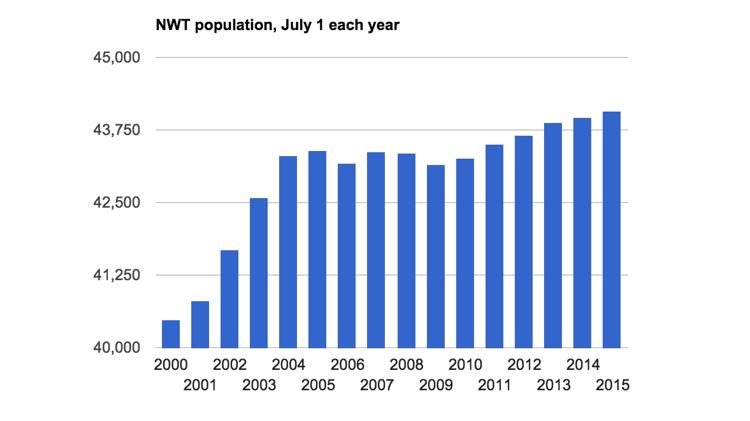
These numbers may come as a surprise. The accepted narrative for some time has been of a territory on the verge of hemorrhaging residents, and this has already been the basis of much political campaigning as we approach the municipal, territorial and federal elections.
So where does the suggestion of falling population originate? The answer: Statistics Canada.
Last time Statistics Canada issued its quarterly population figures, the data showed a drop of 491 people in the NWT between April 2014 and April 2015 – for a total of 43,234 people.
Now, Statistics Canada’s revised figure for April 2015 – as published by the NWT Bureau of Statistics – is 44,150. That represents a year-on-year gain of 258 people, using the latest available figures.
In the space of three months, Statistics Canada’s best guess for the NWT’s population in April 2015 varied quite dramatically. So Moose FM asked Statistics Canada to explain why.
‘More fluctuation’
“We use administrative data that evolves through time,” said André Lebel, a demographer working for Statistics Canada, reached by phone on Wednesday.
“We release our July estimates before October, for example, so we have to work with the data we have. As we get better data, we update our estimates.
“We need to be able to release information quickly but we have a revision process. The estimate is preliminary, then revised, then finalized – usually two to three years after it was first published.”
Lebel says one example of delayed information relates to births and deaths, which take time to reach Statistics Canada after being initially registered and subsequently collated by the territory.
He says the NWT’s birth rate is largely responsible for the territory’s population increase, offsetting a steady number of people moving away to other provinces and territories each quarter.
“When we’re estimating population for small territories, or even Prince Edward Island for example, there is more fluctuation between the preliminary and final estimates. That’s normal,” said Lebel.
“I would be confident talking about these numbers, knowing some of their limitations,” he added. “We put a lot of trust in that data.”
The NWT’s population figure for July actually represents a slight decrease on January and April, which were higher, but Lebel believes quarter-on-quarter comparisons are less useful and a fair amount of seasonal variation exists.
There is, of course, the possibility that Statistics Canada may yet revise its July 2015 figure downward.