The resource revenues received by NWT Aboriginal groups in the first year since devolution have been revealed.
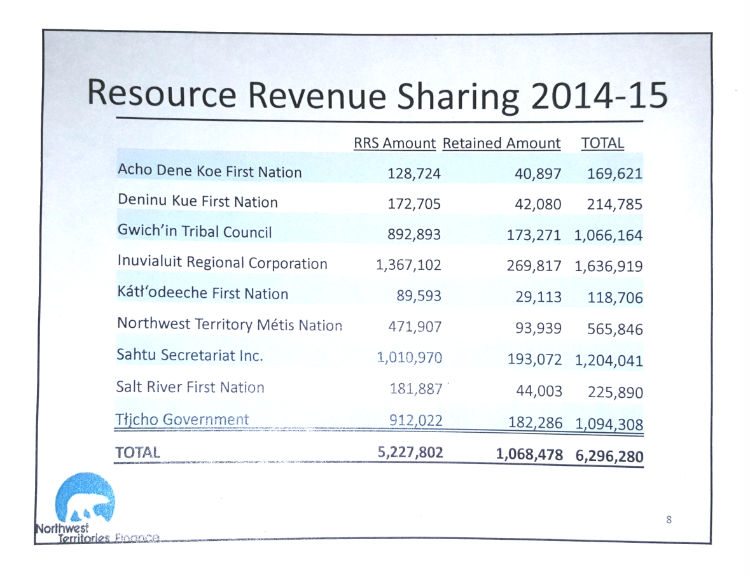
In total, $6,296,280 in money from oil, gas and mining was distributed by the territorial government to nine groups for 2014-15. That’s well below the territory’s earlier estimates.
A formula decides how large a sum is received by each of the nine. Population size dictates how 70 percent of the money is shared, with regional cost of living determining how the remainder is divided.
In a briefing late last week, the territory’s Department of Aboriginal Affairs and Intergovernmental Relations (DAAIR) said the Inuvialuit Regional Corporation earned the biggest slice under that formula: $1,636,919.
The Sahtu Secretariat received $1,204,041, the Tłı̨chǫ Government was given $1,094,308 and the Gwich’in Tribal Council’s payment amounted to $1,066,164.
At the moment, two major groups – the Dehcho and Akaitcho First Nations – have not signed on to the devolution deal and do not receive these payments. The payments they would have received, had they signed on, are referred to as “retained amounts”.
Each year, the territory asks the Aboriginal signatories to devolution to decide how the retained amounts should be spent. For the year 2014-15, those nine groups decided to split the retained amounts evenly between them. The figures on this page represent the overall total received by each group, including those retained amounts.
Revenues explained
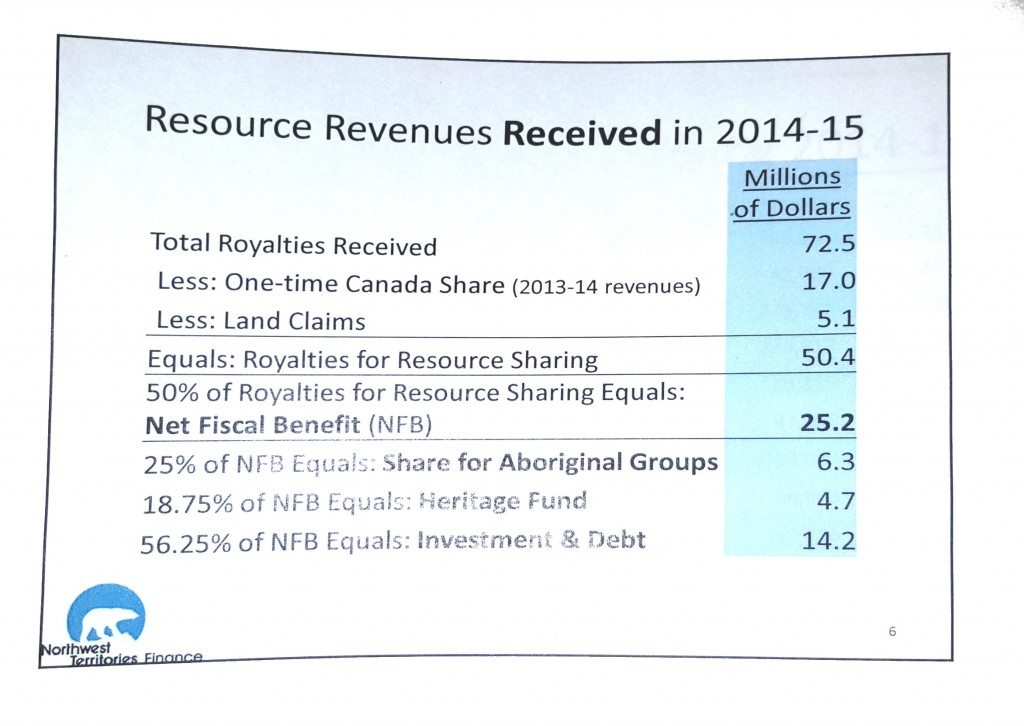
For the calendar year of 2014, the territory itself received a grand total of $72,500,000 in resource revenues from royalties paid by oil, gas and mining companies operating in the NWT.
Of that initial figure, $17,000,000 is owed to the federal government as a one-off payment to cover January to March 2014, a period prior to devolution. A further $5,100,000 is subtracted for land claims.
That leaves $50,400,000, which is the working total used to calculate how much Aboriginal groups should receive. The federal government takes half of that – $25,200,000 – and then 25 percent of the remainder is given to Aboriginal groups ($25,200,000 divided by four, so around $6,300,000).
A further 18.75 percent of the remainder goes to the NWT heritage fund – a kind of long-term savings account for the territory – so the present territorial government is left with $14,200,000 in resource revenues from 2014-15. That sum will be used to offset some infrastructure costs and service some debt payments.
Well below estimates
DAAIR admits the figures here are considerably lower than pre-devolution estimates, which had been based on a five-year average of resource revenues reported in the federal government’s public accounts.
As recently as February, despite revising its estimates downward, the territory had still hoped to keep more than $20 million for infrastructure and debt payments, and award more than $10 million to Aboriginal governments.
DAAIR says the territory’s resource industries have simply not performed as well as in earlier years – and Aboriginal groups are regularly updated to ensure they are not surprised by lower payments.
These figures, says DAAIR, will appear somewhat different in the territory’s next set of public accounts. That’s because the $50,400,000 figure reflects a calendar year, whereas the public accounts are based on a fiscal year.
After factoring in accounting measures to translate the figures from calendar to fiscal years, you can expect the public accounts to show the working total of royalties for 2014-15 as $63,700,000 (not $50,400,000) – still some $17,000,000 short of its revised estimate in February 2015.
In February, the territory said resource revenues made up around 4.4 percent of its overall income.