




Premiers of the North and west focused on economic corridors at the conclusion of the Western Premiers’ Conference, but Dene Nation leadership criticized what they called lack of Indigenous representation.
The Western Premiers’ Conference came to a close on May 22 in the city of Yellowknife. Premier Simpson told True North FM that he anticipated a constructive meeting and a chance for leaders to explore shared concerns.
“As Premier, I’m looking forward to discussions on key national and regional priorities, including international trade, economic and energy corridors, Arctic security, emergency preparedness, and housing. These meetings provide an opportunity to strengthen provincial and territorial collaboration and explore how Premiers can collectively advocate for robust federal responses to shared challenges,” said Premier Simpson.
Prime Minister Mark Carney is scheduled to hold a conference in about two weeks with the premiers of each province and territory in Saskatoon, Sask.
A press conference was held at the conclusion of the premiers’ conference, where international trade, economic and energy corridors seemed to be the major focus of the discussion. Manitoba Premier Wab Kinew was not in attendance but B.C. Premier David Eby, Sask. Premier Scott Moe, Alta. Premier Danielle Smith, Nunavut Premier P.J. Akeeagok, Yukon Premier Ranj Pillai joined NWT’s Premier R.J. Simpson.
Sask. Premier Moe emphasized that opening up a “new West partnership” between the provinces and territories is an important step.
He emphasized that conversations around breaking internal and international trade barriers were a pivotal moment of the conference.
“Creating access for the European and Asian markets for a significant portion of Canadian goods, access to those European and Asian markets looking at investments throughout Northern Canada. Connecting through a corridor some of our Northwest ports with potential ports in Hudson Bay. How you could build off that core piece of infrastructure to really add to our Arctic security, connecting maybe an Arctic Port, down the way or even further connecting to that core corridor infrastructure, that port connection, out into areas in Eastern Canada as well,” he continued.
Nunavut Premier P.J. Akeeagok and Yukon Premier Ranj Pillai agreed that the creation of such a corridor was a point of agreement.
B.C. Premier David Eby and Alta. Premier Danielle Smith added that they were excited about the prospect of a connecting corridor along the West coast linked to the North and south going eastwards, via rail and waterways.
Although Premier Eby and Premier Smith said they needed to work out some areas of disagreement, they strongly agreed on the need for an economic corridor that accesses the ports in the Northwest to B.C. and port sites on Hudson’s Bay.
“We had really constructive conversations about interties built so that we could have electricity coming back and forth from Manitoba all the way through to British Columbia back again. And when you look at the rail line, there’s just such an extraordinary opportunity for all of the provinces, to export all of our products out of the Port of Prince Rupert, it already exports 30 million tons a year,” said Premier Smith.
Yukon Premier Pillai spoke about the urgency of acting quickly.
“We have to see movement now,” said Premier Pillai.
Pillai said that action was critical to develop the “Economic potential of the west,” especially over the next few years as the country goes through the tariff threats. Pillai also touched on the “uniqueness of trade in North.”
Pillai emphasized the importance of consulting with Indigenous governments as they sit down to do this work.
Premier Simpson said N.W.T. is “heavily involved” in those discussions and is chairing the committee on internal trade.
N.W.T. also shares a land border with most of the provinces and territories in Canada’s west and North.
“One thing that we’ve raised time and time again and Premier Pillai just spoke about it is the fact that North is different. We’re 40 per cent of Canada and we’re the population of a small City. And we also have, as was mentioned, modern treaties that we need to uphold and that we will uphold,” said Premier Simpson.
The Premier said he will continue to advocate to support local businesses in the North.
“We’re also in a situation where, because we’re a small economy, we’re a developing economy, we need to ensure that when we’re spending money in the North that 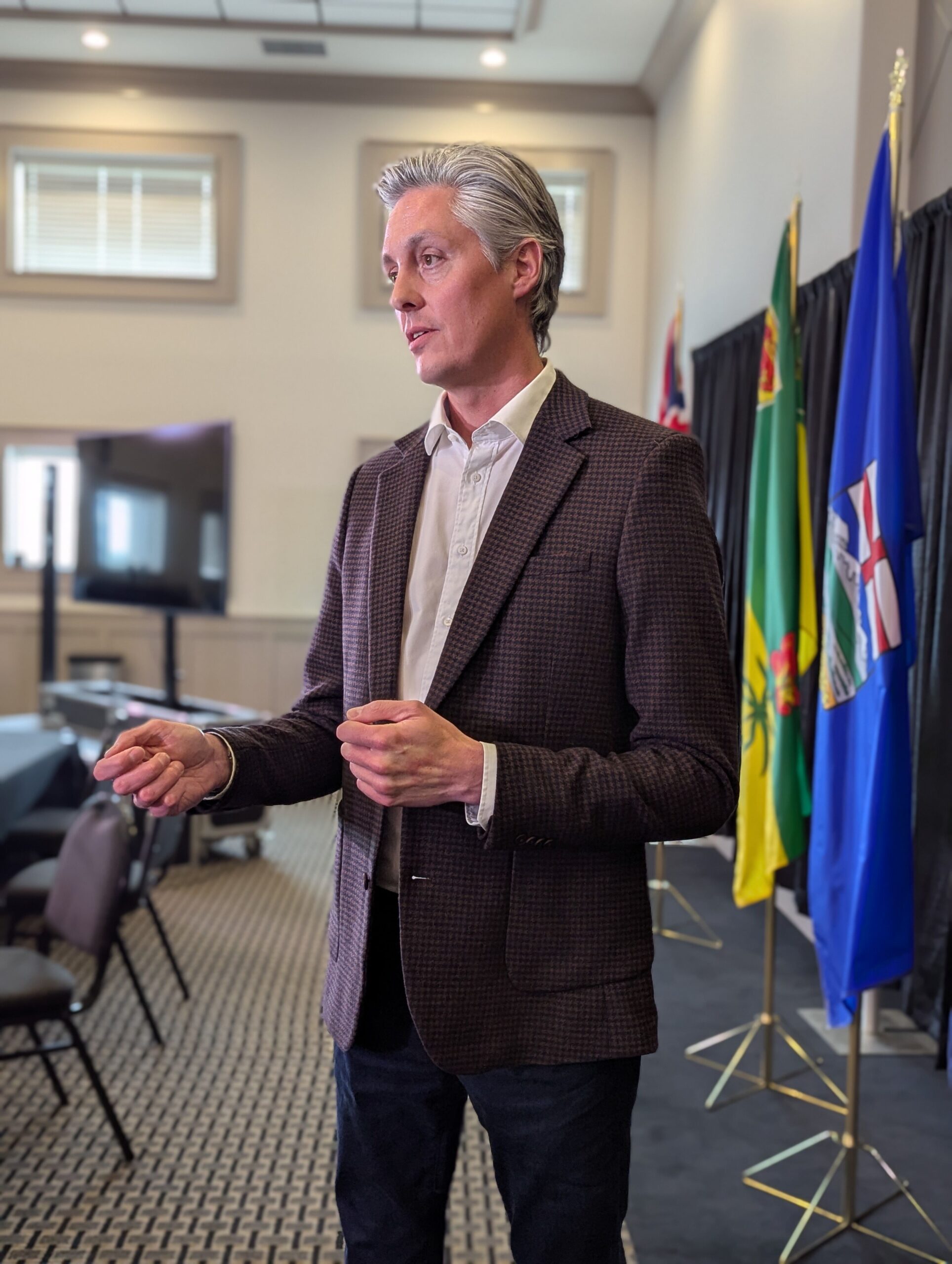 it’s benefiting Northerners. We’re not opposed to companies from other parts of Canada to come up here and do business and work, but we need to make sure that we have the ability to support local businesses, so that we don’t just become a colony for the rest of Canada,” he added.
As the Western Premiers conference concluded, Dene First Nation leaders, including Dene National Chief George Mackenzie, were vocal about what they said was a lack of Indigenous acknowledgement and engagement at the conference.
Dene National Chief George Mackenzie issued a statement on May 22 regarding the May 21 reception held at the N.W.T. Legislative Assembly:
“The Government of the Northwest Territories (GNWT) has once again demonstrated a concerning disconnect between territorial governance and the people they serve. Yesterday’s Western Premiers Conference reception at the Legislative Assembly was a stark reminder of the ongoing challenges Indigenous peoples face in achieving proper recognition and representation in our territory,” said Chief Mackenzie.
Chief Mackenzie expressed a concern about Indigenous leadership being “notably absent” from the event.
“It is deeply troubling that in 2025, in a territory where Indigenous peoples make up 49.6% of the population, our presence and protocols continue to be overlooked at official government functions,” stated Dene National Chief George Mackenzie. “The failure of the Deputy Ministers and the Premier to acknowledge Indigenous leadership, particularly the office of the Dene National Chief, speaks volumes about the current state of the relationship between the GNWT and Indigenous peoples,” said Chief Mackenzie.
Premier Simpson said that Indigenous involvement was at the “forefront” of discussions throughout the conference.
“That was kept at the forefront by actually, all of the premiers. All of us at one point or another raised it at one point or another during the different discussions because it is so much at the Forefront,” said Premier Simpson.
“We have modern treaties that we’re committed to uphold. So when we talk about things like resource development, that’s ensuring that there is Indigenous partnership when we’re talking about investing in infrastructure, we’re talking about ensuring there’s Indigenous proponents in those projects,” Premier Simpson added.
Chief Mackenzie pointed out that Indigenous communities represent the largest demographic group in the N.W.T. with 49.6 per cent of the population of N.W.T. identifying as Indigenous.
In their announcement, the Dene Nation reminded government officials to ensure meaningful engagement, including in matters of protocol and ceremony. They called for relationship building with Indigenous leadership who represent the majority of the territory’s population.
“This is not merely about protocol – it is about respect, recognition, and the fundamental right of Indigenous peoples to be represented in territorial affairs,” Chief Mackenzie added.
The Dene Nation called for a formal acknowledgment of what they say was an “oversight.” They also called for the Implementation of “proper protocols” for Indigenous leadership at all government functions and the establishment of “clear” guidelines to ensure proportional representation at territorial events






