100.1 GO FM - We're Your Feel Good Pop Station

Get an air purifier, Department of Health tells NWT residents

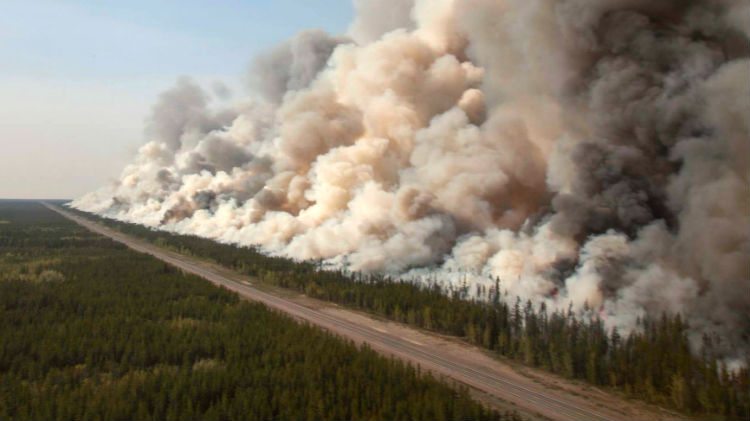
The Northwest Territories Department of Health wants residents to invest in air purifiers as smoke descends on northern communities.

Hay River, Yellowknife and other NWT communities spent portions of last week under air quality alerts because of smoke from wildfires in the region. Many residents became accustomed to smoky conditions during last year’s prolonged wildfire season.

Dr Kami Kandola, the territory’s deputy chief medical health officer, believes an air purifier with a HEPA filter is a must-have for residents dealing with exposure to smoke over a period of weeks.

“Wildfires were an issue across Canada last year, and a group – mainly out of BC – did a systematic review of wildfires, smoke, and the best intervention to limit the impact,” Dr Kandola told Moose FM.

“One they came up with was having a clean-air shelter or supply, and that means a type of filtration you can have indoors to filter most of the smoke particles – so that when you’re in that setting, there is less particulate matter. That was the best lesson learned.

“If you have that type of cleaner indoors, it really does reduce your exposure to small particles of smoke. You can find these cleaners in any hardware store or local department store. Look at the box to see how much space it can clean, so it matches your room size.”

More: Air purifier reviews at Consumer Reports

Most good-quality air purifiers cost well over $100, up to $300 or more, so they represent a sizeable investment. Dr Kandola says it’s worth it, to ensure particles from smoke don’t “get trapped deep in the lungs and trigger coughing” or other conditions.

Dr Kandola also took the time to repeat the territory’s standard advice for dealing with smoky conditions.

“Smoke in the air can impact on health, particularly vulnerable populations like children, the elderly, or people with heart and lung disease,” she said.

“Stay well-hydrated with lots of water. You should reduce or reschedule strenuous activities, particularly if experiencing coughing or throat irritation. Keep windows and doors closed, don’t smoke inside, and stay away from people who do.

“If you’re in the car, put the air system on recirculate.

“If you experience symptoms like chest tightness, chest pain, shortness of breath or fatigue, talk to your community health nurse or doctor.”


Ollie Williams
Ollie Williams
Hello! I'm the one with the British accent. Thanks for supporting CJCD. To contact me, you can email me, find me on Twitter or call (867) 920-4663.

Continue Reading

You may also like


cjcd Now playing play

- Advertisement -

Related Articles

- Advertisement -

Latest News

Inuit Nunangat University to begin regional knowledge centre site selection

Following the selection of Arviat, Nunavut, as the site of Inuit Nunangat University’s main campus, the process to choose regional knowledge centres and satellite campuses across Inuit Nunangat is underway. Arviat, with a population of about 3,000, is Nunavut’s third-largest community and has one of the highest proportions of youth in the country.

Premier supports “dual use” aspects of country’s first “Defence Industrial Strategy”

The federal government announced the strategy Monday, describing it as the country’s first national defence industrial strategy. Simpson said those elements are particularly relevant to the North. He said equipment and technology systems intended for use in the Arctic should be tested in the territory’s northern climate and developed in partnership with northern governments, Indigenous rights holders and communities.

Nominee Program opens up for 2026

The Northwest Territories Nominee Program will be opening applications for the employer-driven and francophone streams starting March 9 at 9am.  

Yellowknife Fire Fighter Association campout fundraiser to be held this weekend

The Yellowknife Fire Fighter Association will be holding a campout this weekend on the roof of the Yellowknife CO-OP to raise funds and awareness for Muscular Dystrophy Canada. 

Search continues for ways to deal with 200,000 tons of arsenic dust at Giant Mine

Scientists presented projects for a more permanent solution to hundreds of thousands of tons arsenic dust from the mine. One method uses local beer to fuel a transformation of the toxic dust, while another tries to turn it into glass. Another proposed method looks at turning the dust into a highly sought commodity known as metallic arsenic. Additional proposals look whether robotic technology could allow crews to virtually pilot the extraction of the dust while “sipping coffee” from a distance.