
Hay River set for shipping boom with Nechalacho

Hay River is set to become a distribution hub for the Nechalacho Rare Earth Resources Project, according to executives from Cheetah Resources.

Representatives from the mining company, including vice-president David Connelly, were at the Hay River town council meeting, laying out their plans for using Hay River’s port as one of the key points for distributing its ore down south.

The ore is being crushed with the mine’s new sorter before the company’s new Saskatchewan sorting facility is finished construction.

Ore will be shipped down from the mine via rail and leave Hay River via barge to the plant in Saskatchewan.

Vice President of Strategy and Corporate Affairs David Connelly said in an email the mine’s operations would “significantly increase the marine, truck and rail freight through the Port of Hay River.”

“For us to this would be nice if this is a distribution hub once there’s a bit more activity up here,” said Matthew Edler, General Manager of Cheetah Resources.

“Barge route should be the most efficient way of getting — it is by far the most efficient way: it has the lowest carbon footprint, cheapest,” he added.
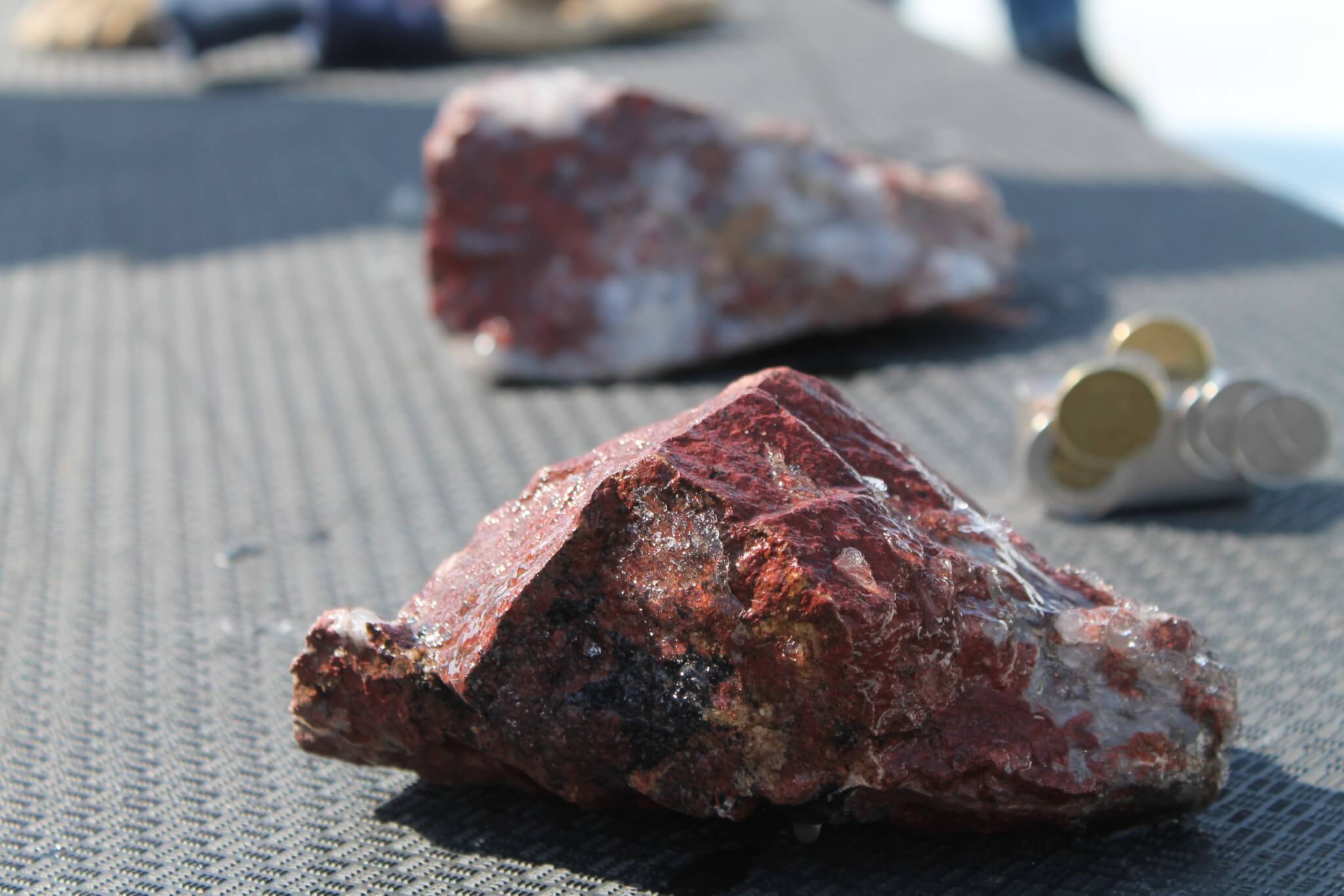
Basnaesite, the product produced at Nechalacho, is a big grouping of a bunch of rare earth metals. (Photo by MyTrueNorthNow.com.)

Ore will also be stored in Hay River in between shipments, rather than being shipped to the sorting plant in Saskatoon.

“Spills, I don’t want because that’s worth money to me,” Edler said. “There’s always a chance of accidents happening and we’ve got basically, basically the process if there is a spill is to collect it and get it back — so it’s a matter of a sweep up and store cleanup of it. But in itself, it’s not hazardous. It’s not toxic.”

Edler added the ore would look like bags of cement.

Hay River Mayor Kandis Jameson said she looked forward to working with the company in the future.


Bailey Moreton
Bailey Moreton
Bailey is new to the north, arriving from Ottawa where he studied journalism at Carleton University. He has worked for newspapers in Halifax, Windsor, and Ottawa. He came to the north hoping to see polar bears. He will settle for a bison. If you have a tip, send it to 905 252-9781, or [email protected].

Continue Reading

You may also like


cjcd Now playing play

- Advertisement -

Related Articles

- Advertisement -

Latest News

GNWT launches Be Ready! Campaign

The Government of the Northwest Territories is launching this year’s Be Ready! Campaign to help Northerners prepare for emergencies like floods, wildfires, and power outages. The overarching theme this year is Individual and Household Emergency Preparedness.

YK Choral Society holding spring concert this weekend

The YK Choral Society is holding their spring concert this weekend. ‘Change Makers’ will be performed this Saturday, April 11 at 2pm and 7:30pm at the Northern Arts and Cultural Center.

GNWT says Sambaa K’e Access Road on closure notice

GNWT’s Department of Infrastructure says Sambaa K'e Access Road has been placed on closure notice. On Tuesday afternoon, the department issued a 24 Hour Notice of Closure Caution at Sambaa K'e Access Road from 803 m southwest of km 4 to 817 m southwest of km 112. Officials said that the road "may close sooner with little to no notice."

Feds commit $20 million for new water treatment plant in Hay River

Northwest Territories MP and Crown-Indigenous Relations Minister Rebecca Alty has just announced an investment of about $20,100,000 from the federal government for construction of a new water treatment plant in Hay River. The new plant would provide clean drinking water to Hay River as well as Enterprise, Kátł’odeeche First Nation and Ka’a’gee Tu First Nation. The announcement was made Tuesday at Hay River Council Chambers.

“Abrimot are everywhere” in Yellowknife’s Mots dans la taïga: In pictures

Festival de poésie arctique Mots dans la taïga at École Allain St-Cyr returned to Yellowknife this week. The "Boreal magic"  of the poetic trail is a space of living language and transformation. More than one hundred students created the hundreds of abrimots that are on the ground, in the trees and tucked into hideaway corners of the snowbanks along the trail. Students from Yukon also contributed along with community members from across the North.