



Sobering Centre should return to capacity as indoor restrictions loosen: Chief Medical Doctor

With the lifting of restrictions on indoor gatherings, the GNWT says Yellowknife’s Sobering Centre should be up to full capacity.

The day shelter has been running at a reduced capacity since the pandemic began. But now the GWNT has lifted, the capacity should return to normal, according to AnneMarie Pegg, NWT’s chief medical doctor.
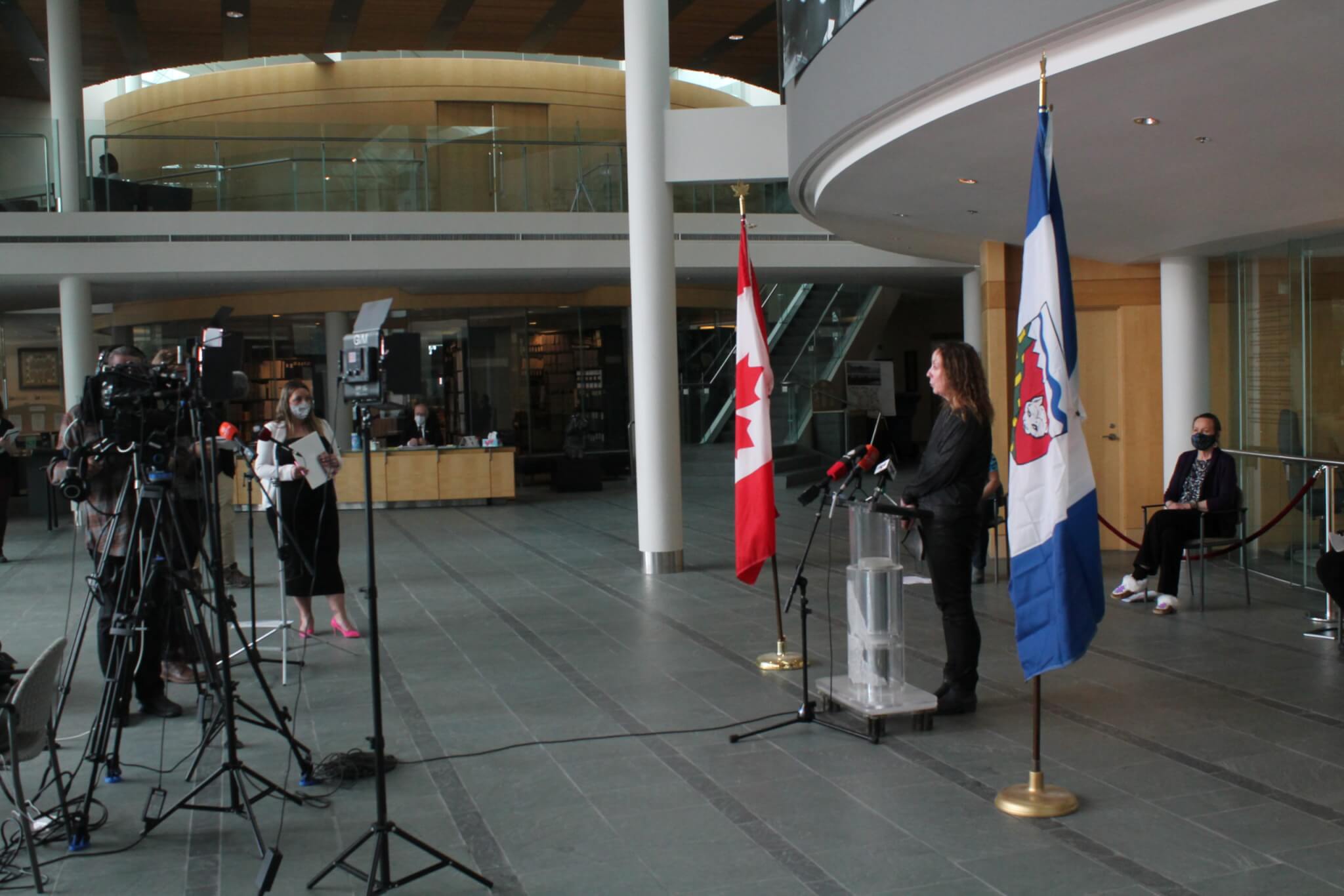
Dr. AnneMarie Pegg speaking at the Legislative Assembly. (Photo by Bailey Moreton/MyTrueNorthNow.com.)

“We are still looking at how best to ensure safety both for users of shelters and for staff working in them, given the fact that this is a population that is a pocket of vulnerability with regards to the vaccination coverage,” she said.

The shelter would qualify as one of the locations at higher risk, according to NWT’s Chief Public Health Officer Dr. Kami Kandola, because of the crowded conditions. 

She said the GNWT would defer to the NWT Disabilities Council, who runs the Sobering Centre, on any decision about returning to capacity.

“We provide high level relaxing advice. But that doesn’t mean that high risk institutions that have been vulnerable patients or vulnerable clients or are crowded or congregate, such as corrections facilities, long term care facilities, healthcare facilities or shelters don’t have their own policies to be put in place or have additional restrictions,” she said.

The temporary day shelter, held at the Mine Resources building, was shut on May 31. That shelter was set up because of the reduced capacity at the existing Sobering Centre due to COVID-19 restrictions.

An appeal filed with the city means the GNWT had to shut down temporary services at Aspen 

Apartments until a review of the permit is completed.

The health department had shortlisted a vacant lot on 51st Street as a location for a new, permanent day and overnight shelter. The plan is for the space to accommodate 99 people in total, with 60 people able to use the day shelter at a time, as well as 30 overnight beds. 

But that space likely won’t be built until 2024 as the territorial government looks for ways to give service to the city’s homeless population.

A spokesperson for the Department of Health and Social Services says work on a permit application will start later in the summer or early fall, when a design team has been contacted.


Bailey Moreton
Bailey Moreton
Bailey is new to the north, arriving from Ottawa where he studied journalism at Carleton University. He has worked for newspapers in Halifax, Windsor, and Ottawa. He came to the north hoping to see polar bears. He will settle for a bison. If you have a tip, send it to 905 252-9781, or [email protected].

Continue Reading

You may also like


cjcd Now playing play

- Advertisement -

Related Articles

- Advertisement -

Latest News

Tuktoyaktuk RCMP lay charges in bootleg liquor investigation

Tuktoyaktuk RCMP are laying charges following an investigation into liquor bootlegging earlier this week.

Youth engage with Tłı̨chǫ language in unconventional immersive spaces

While in-person On the Land learning continues to be central to Tłı̨chǫ language revitalization, the Tłı̨chǫ language division is looking at ways to engage with youth through new immersive platforms, like virtual spaces, that honour history and traditions. Danielle Dacanay with the Tłı̨chǫ Government’s Language Division emphasized that virtual resources are supplements to learning the language in the traditional way, they are not a replacement for it.

New microgrant stream wants youth to plant language seeds outside school

“100 youth projects wanted in French,” a new microgrant program wants youth to plant language learning seeds outside school. A network of action-research teams in Canada, other parts of North America, Africa and Europe is launching a youth grant stream to support French language engagement outside of conventional spaces. Youth across the country aged 14 to 30 are eligible for 100 microgrants in support of grassroots initiatives as part of this program run by the Dialogue Network.

Water testing at another Yellowknife school confirms elevated lead and copper

Testing at another school site in the city of Yellowknife showed elevated levels of lead and copper in water present in some of its drinking taps. Earlier this month, testing showed four other school buildings in Yellowknife and a school in Behchokǫ̀ had elevated levels of both copper and lead in water. Since comprehensive testing of schools across the territory began this fall, 28 school sites out of 34 announced to date have tested positive for elevated levels of lead.

Testing at more NWT buildings confirms lead in water

Fort Smith officials said water testing at municipal buildings has confirmed the presence of lead. According to the announcement, water samples at the Town Hall, the Fire Hall, and the Municipal Services Building continue to show elevated levels of lead.


