
Self-isolation requirements for NWT residents travelling back into the territory have been cut.
The Chief Public Health Officer Dr. Kami Kandola has also taken back her recommendation against non-essential travel.
Fully vaccinated residents will now not have to self-isolate after travelling outside the territory after the 7-day rolling average for the number of new COVID-19 cases nationwide dropped to 928.
The partial vaccination rate also reached 66.8 per cent, meaning both the GNWT’s benchmarks it had set out in its updated Emerging Wisely plan had been met.
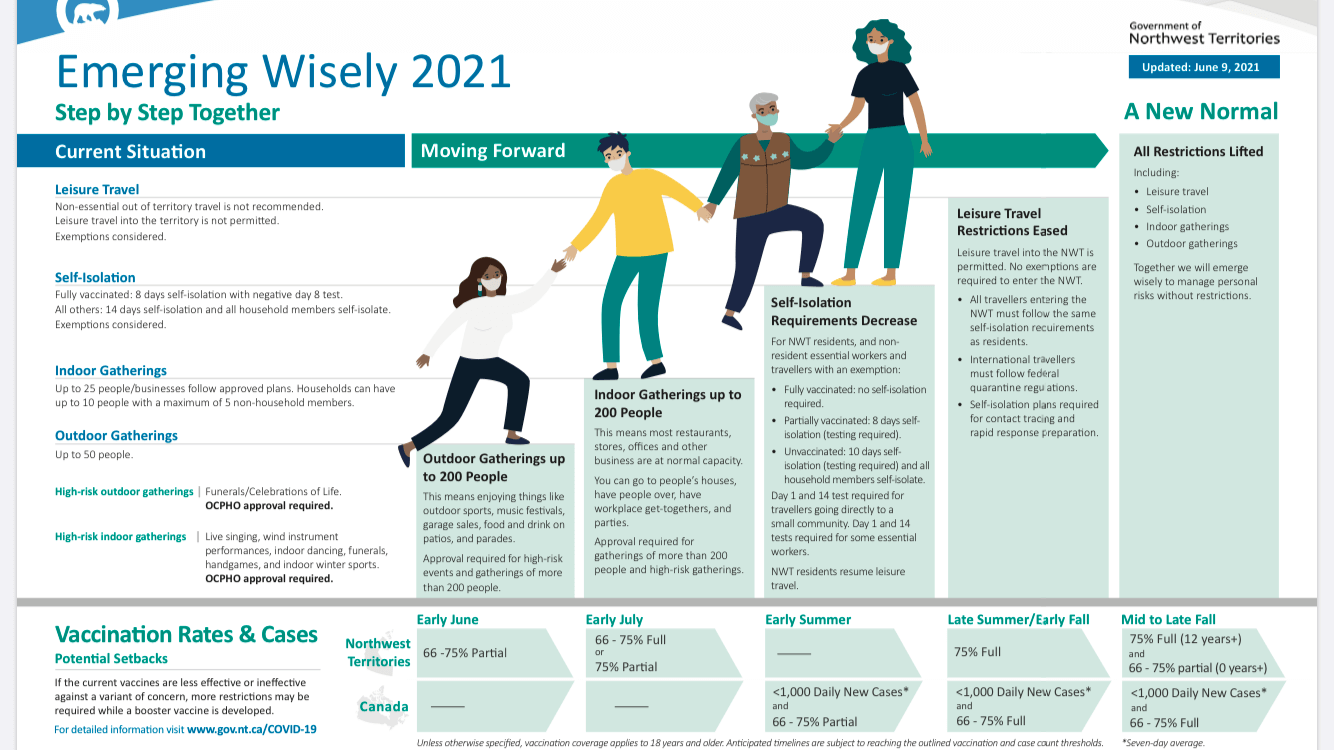
Indoor restrictions had been supposed to be lifted next in the GNWT’s proposed timeline, but those were tied to the territory’s vaccination rate, which is still below the 66 to 75 per cent full vaccinated or 75 per cent partially vaccinated benchmark.
There are some restrictions travellers will still have to meet.
People who are partially vaccinated are still required to self-isolate for a minimum of 8 days and get tested on the last day. People who are unvaccinated, including children under 12, are required to self-isolate for a minimum of 10 days with a negative test on day 10. Children under 2 will not be required to get a test on day 10 but have to isolate until then.
A day 1 test and a day 14 test are required for people travelling from outside of the NWT to a small community and for some essential workers.
NWT residents won’t need proof of their vaccination but travellers who got their vaccines outside the territory will need proof of vaccination.
These reduced self-isolation requirements also apply to non-residents that have been granted permission to travel into the NWT through an exemption process.
Housemates of the person who has travelled have to follow the same isolation requirements as the travelling person, even if they have been fully vaccinated.
Indoor restrictions are still yet to be lifted. The GNWT’s timeline for loosening other restrictions had things like allowing leisure travel coming late in the summer.
Allowing leisure travel into the NWT will come when the NWT is 75 per cent fully vaccinated for the population aged 18 years and over, and there are less than 1,000 cases reported a day in Canada, and the country is reporting a fully vaccinated rate of between 66 and 75 per cent.
Lifting all restrictions will require a 75 per cent full vaccination rate in the territory and 66 to 75 per cent in the whole of Canada, with the number of daily cases staying below 1,000.
Lifting all restrictions would also require the total population, including those under 12, to have a partial vaccination rate of 66 to 75 per cent. None of the COVID-19 vaccines as of yet have been cleared for use in children aged 12 years and younger.
The GNWT warned COVID-19 variants of concern could throw off the restrictions loosening schedule. In the event a booster vaccine is needed to protect against variants of concern, more restrictions could be added.