
Effective Wednesday, public health restrictions on outdoor gatherings will be relaxed for events up to 200 people, if physical distancing is possible.
That’s the first in a scheduled loosening of restrictions included in the GNWT’s updated Emerging Wisely Plan.
Indoor restrictions are set to be the next to be loosened, with the GNWT setting early July after the school year ends as the timeline for that change to happen.
The new plan says that by early summer the GNWT anticipates that it’ll allow fully vaccinated travellers to travel without being required to self-isolate.
Partially vaccinated and unvaccinated travellers will also see rules loosen, but will still have to self-isolate, just for a shorter period of time.
By the fall of 2021, the GNWT says it anticipates all public health restrictions in the NWT will be lifted, with timelines tied to vaccination rate thresholds.
Indoor restrictions will be loosened around when the territory reaches 66 to 75 per cent fully vaccinated or 75 per cent partially vaccinated. Currently, the territory is at 62 per cent fully vaccinated, and at 69 per cent partially vaccinated.
The later goals are tied to the COVID-19 picture in the rest of the country.
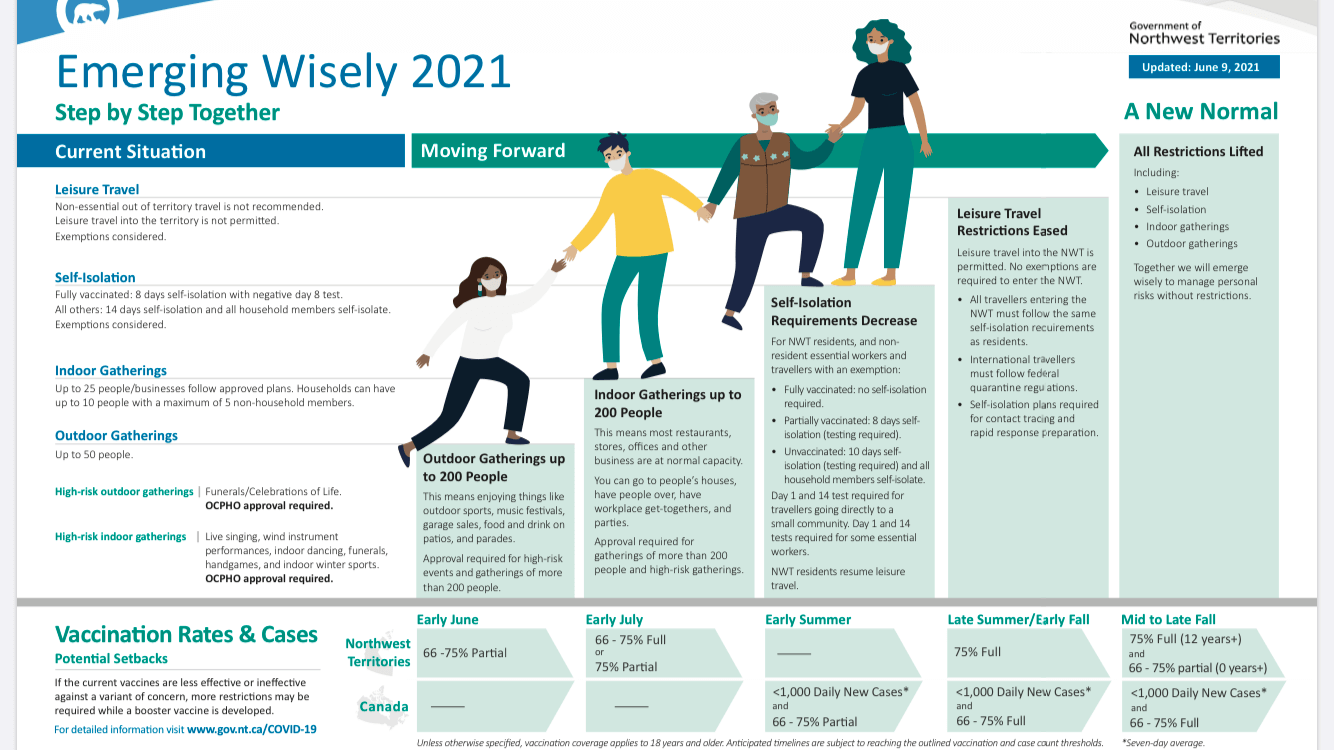
Cutting self-isolation requirements for domestic travellers depends on the vaccine rate in the rest of Canada and the number of cases. Those changes will be made around when Canada is reporting less than a thousand cases of COVID-19 a day and Canada has a partial vaccination rate of 66 to 75 per cent.
Allowing leisure travel into the NWT will come when the NWT is 75 per cent fully vaccinated for the population aged 18 years and over, and there are less than 1,000 cases reported a day in Canada, and the country is reporting a fully vaccinated rate of between 66 and 75 per cent.
Currently, Canada has a partially vaccinated rate of 63 per cent, but a fully vaccinated rate of only 8.5 per cent. Yesterday, there were 1,271 cases declared. That’s up slightly from the 1,232 reported on June 7 but well below levels a month ago, when case numbers were above 7,000 a day at the beginning of May.
Lifting all restrictions will require a 75 per cent full vaccination rate in the territory and 66 to 75 per cent in the whole of Canada, with the number of daily cases staying below 1,000.
Lifting all restrictions would also require the total population, including those under 12, to have a partial vaccination rate of 66 to 75 per cent. None of the COVID-19 vaccines as of yet have been cleared for use in children aged 12 years and younger.
The GNWT warned COVID-19 variants of concern could throw off the restrictions loosening schedule. In the event a booster vaccine is needed to protect against variants of concern, more restrictions could be added.