



Travellers from Yukon can now be granted self-isolation exemptions

Travellers from the Yukon will no longer have to self-isolate, as long as they are granted an exemption by the CPHO.

The change gives Yukon residents the same requirements for travelling to the NWT as those from Nunavut.

There are a number of requirements travellers have to meet, including receiving an approved exemption letter from the Chief Public Health Officer before travelling.

Travellers also must not have travelled from another area of the country for at least 14 days before entering the NWT. They must also not be displaying symptoms of COVID-19.

Travellers won’t be granted an exemption if they are coming from a community with travel restrictions in place, or one that’s experiencing community transmission of COVID-19, or if they’re a worker at a Yukon camp or work site that has out-of-territory workers.      

Health Minister Julie Green says the combination of a low number of cases and progress with the vaccine roll-out mean they can go ahead with the change.

“There are strong ties between both of our territories and this change will allow families and friends on both sides of our borders to see each other again while continuing to keep our territories and communities healthy and safe,” she said in a statement.
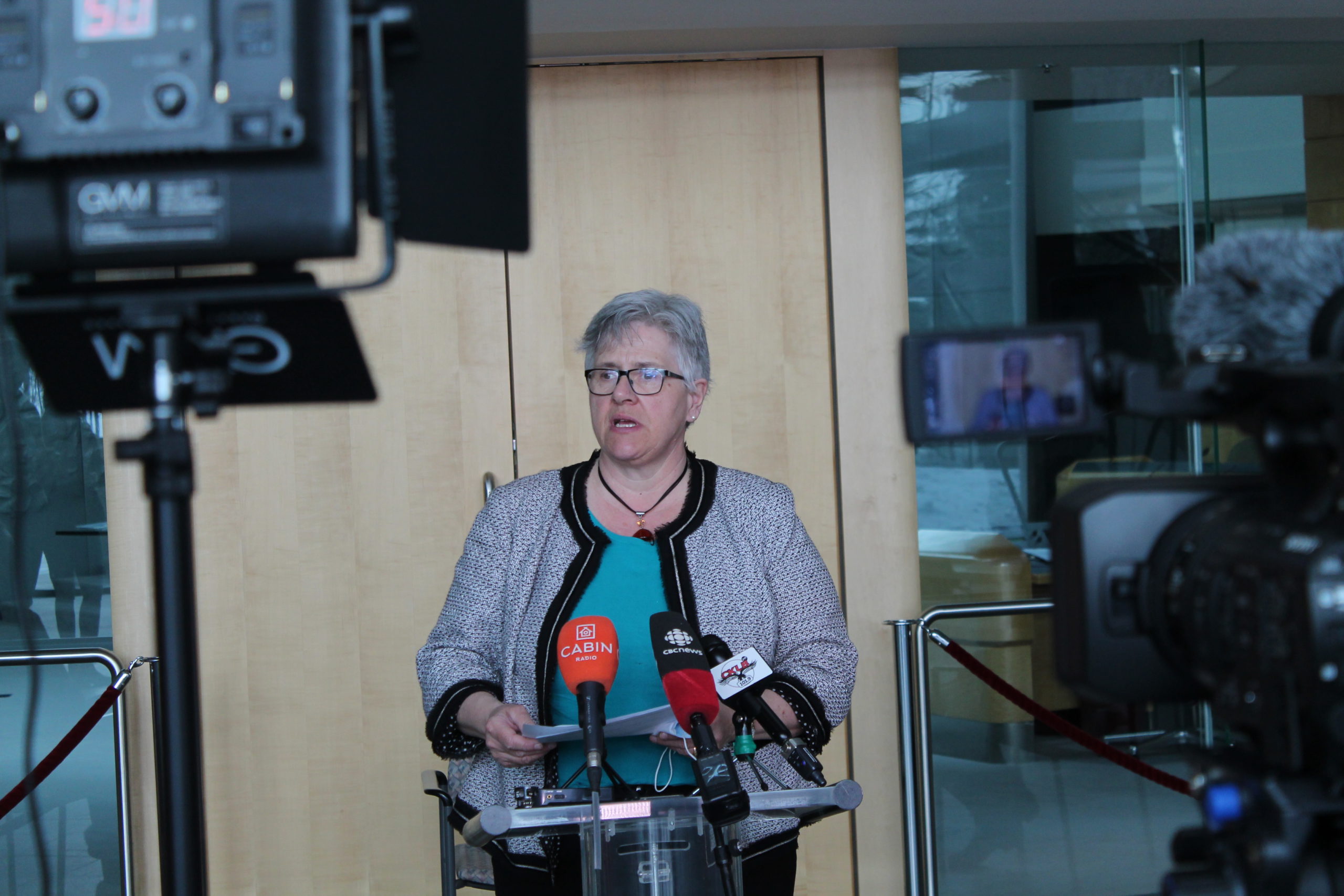
Health Minister Julie Green speaking at the Legislative Assembly. (Photo by Bailey Moreton/MyTrueNorthNow.com.)

Inuvik Twin Lakes MLA Lesa Semller has called repeatedly on the GNWT to make changes to allow travel across the Yukon border for communities who live in the Beaufort Delta. 

The Dempster Highway, the only road connection to northern communities like Inuvik, travels through Yukon, meaning residents in northern communities have been cut off from access to other parts of the territory, unless they flew.

“The Dempster Highway is the only way in and out of the Beaufort Delta by road,” she said.
“It’s our lifeline to the rest of Canada. Yes, we are NWT residents, but there is no way for us to get to the rest of the NWT unless we drive through Yukon, BC, and Alberta at this time. Or if we can afford to pay the high cost of an airline ticket, and many cannot.”

Changes to COVID-19 restrictions could be coming more broadly, as the GNWT prepares its release of its updated Emerging Wisely Plan, which would see the removal of the phased approach the plan currently uses.

The plan has seen the NWT remain in stage 2 of COVID-19 restrictions since June 2020.

The change will come into effect when ferry operations on the Dempster Highway start for the year.


Bailey Moreton
Bailey Moreton
Bailey is new to the north, arriving from Ottawa where he studied journalism at Carleton University. He has worked for newspapers in Halifax, Windsor, and Ottawa. He came to the north hoping to see polar bears. He will settle for a bison. If you have a tip, send it to 905 252-9781, or [email protected].

Continue Reading

You may also like


cjcd Now playing play

- Advertisement -

Related Articles

- Advertisement -

Latest News

GNWT issues closure cautions for Wekweètì and Gamètì winter roads

The GNWT’s department of Infrastructure has issued a 72 Hour Notice of Closure Caution for the Wekweètì and Gamètì winter roads. According to the public message posted Sunday afternoon, the roads “may close sooner with little to no notice.” Earlier this month, the Wekweètì and Gamètì winter roads were restricted to night travel only between 10 pm to 10 am.

Tuktoyaktuk RCMP lay charges in bootleg liquor investigation

Tuktoyaktuk RCMP are laying charges following an investigation into liquor bootlegging earlier this week.

Youth engage with Tłı̨chǫ language in unconventional immersive spaces

While in-person On the Land learning continues to be central to Tłı̨chǫ language revitalization, the Tłı̨chǫ language division is looking at ways to engage with youth through new immersive platforms, like virtual spaces, that honour history and traditions. Danielle Dacanay with the Tłı̨chǫ Government’s Language Division emphasized that virtual resources are supplements to learning the language in the traditional way, they are not a replacement for it.

New microgrant stream wants youth to plant language seeds outside school

“100 youth projects wanted in French,” a new microgrant program wants youth to plant language learning seeds outside school. A network of action-research teams in Canada, other parts of North America, Africa and Europe is launching a youth grant stream to support French language engagement outside of conventional spaces. Youth across the country aged 14 to 30 are eligible for 100 microgrants in support of grassroots initiatives as part of this program run by the Dialogue Network.

Water testing at another Yellowknife school confirms elevated lead and copper

Testing at another school site in the city of Yellowknife showed elevated levels of lead and copper in water present in some of its drinking taps. Earlier this month, testing showed four other school buildings in Yellowknife and a school in Behchokǫ̀ had elevated levels of both copper and lead in water. Since comprehensive testing of schools across the territory began this fall, 28 school sites out of 34 announced to date have tested positive for elevated levels of lead.


