
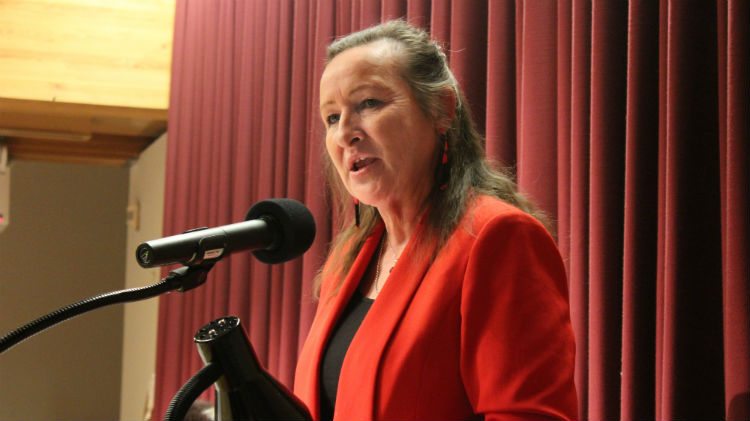
Premier Caroline Cochrane was generally positive about the funding headed for the NWT as she reflected on the federal government’s budget.
In its first budget in two years the federal government announced more than $30-billion for the start of a national child care program by cutting child care costs in half by the end of 2022.
That will include $10 a day for child care by 2025.
The COVID-19 benefits were also extended, while minimum wage was raised to $15.
Conservative leader Erin O’Toole criticized the budget for what he said was insufficient spending towards fighting the COVID-19 pandemic, and criticized the lack of support for the mineral industry.
NWT Member of Parliament Michael McLeod praised the budget’s focus on building a more inclusive economy.
“With NWT-specific investments such as $25 million for housing and $8 million toward the Aurora College transformation, this budget directly addresses some of our territory’s top priorities,” said McLeod.
Indigenous supports
Like in the territorial government’s budget, there was also a focus on infrastructure spending, especially for Indigenous communities, with the federal government establishing a $4.3 billion Indigenous Community Infrastructure Fund.
The budget included $2.2 billion over five years to work towards the goals of the Missing and Murdered Indigenous Women and the Truth and Reconciliation Commission.
There was the creation of a new $150 Indigenous business growth fund, along with $117 million more funding for the existing Indigenous businesses fund.
There is also $73.6 million over four years to support federal legislation that allows Indigenous governments and groups to develop their own child and family services laws.
Cochrane said it would be important to ensure that money doesn’t get double spent in some communities, with the GNWT receiving funding to set up childcare services, adding it would be important to coordinate with Indigenous and the federal government.
Housing money
The federal government outlined $25 million to go towards building 30 public housing units in the NWT.
Cochrane highlighted that support from the federal needs to come in multiple forms, not just in terms of money. She added the GNWT had asked for $100 million over four years, but expected more money would be coming in the future.
“I know that there is more money in the federal budget for housing, that we can actually use our money to leverage,” she said. “There is already money within the federal budget that we can access, more than the $25 million.”
“But we also have to think about what we can do in one year, we’re a small population of 45,000 people,” she added.
Premier Caroline Cochrane said the territorial government needs to make sure it has the capacity to build projects, a problem that had been raised in the past after the $60 million Rapid Housing Initiative fund the NWT had been assigned sat unused for more than a year.
Cochrane said it was too early to say where the public housing units will be built.
Mining industry and climate change
One of O’Toole’s biggest criticisms of the federal budget is the lack of support for the natural resource sector.
But Cochrane said the view that that industry is being left out in this budget is misleading.
“Within the budget, there is climate change money, there’s $5 billion over seven years for the green economy,” she said. “I’ve been saying for the last year and a half, you can’t have a green economy without things like batteries, and batteries can’t grow from the earth.”
She said this funding would create opportunities for mineral mining operations in the NWT to meet the growing need for green technology.
But Cochrane said that $5 billion was not enough to be spending on fighting climate change.
“Absolutely not enough. However, it’s combined in a basket of areas. There’s climate change, green economy, there’s Indigenous rights monies, there’s job creation monies, $1.9 billion over four years, we’re hoping that the Mackenzie Valley highway and the Slave Geological Province Corridor will be amongst those as well,” said Cochrane.
Overall, this budget will see the federal deficit will be just over 354-billion dollars for the past year but it will drop to over 154-billion this fiscal. There was no date provided for when the Liberal government plans to balance its books.