
NWT capital spending sees second biggest increase in the country

The NWT is set to see the second biggest increase in spending in Canada, as the territory tries to kick start its economy post-pandemic with infrastructure projects.

Compared to 2020, overall 2021 capital expenditures for the Northwest Territories are expected to increase by 13.4 per cent to $896 million.

This is the second year in the row spending on capital projects has increased, after five years of increase since 2015. Since capital spending peaked in 2015 with the construction of the Gahcho Kué diamond mine, private investment has trended downward while public investment has also increased.
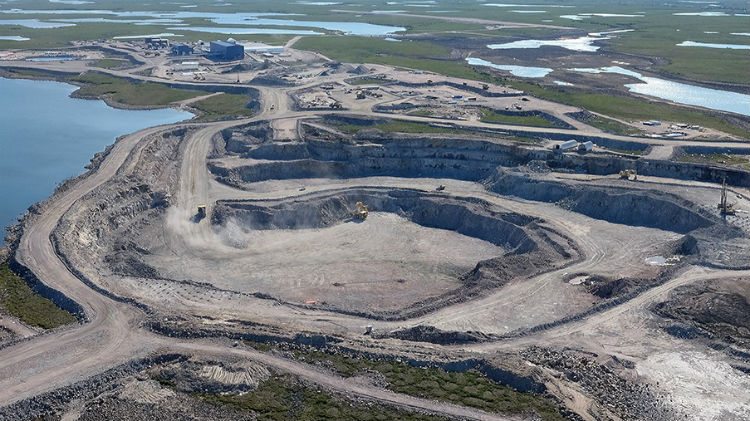
Private investment in capital projects has dropped significantly since Gahcho Kué was constructed in 2015. (Supplied by DeBeers Canada.)

But private investment is well below 2019 numbers. Between 2019 and 2020, private investment halved to $207 million. Private investment is set to grow to $247 million in 2021. 

Finance Minister Caroline Wawzonek said attracting more private investment was a priority for the territorial government moving forward. 

Public spending on capital projects, things like roads and buildings, will increase by 11.5 to nearly $650 million dollars, according to the NWT Bureau of Statistics.

The GNWT’s capital budget outlined $451 million in capital project pending, with Wawzonek saying infrastructure projects would be a priority.

The biggest spending item will be on maintaining and expanding the territory’s roads, highways and bridges, with $61.3 million going towards the Tłı̨chǫ all-season road project. The territory approved more than $180 million in spending on roads.

The 13.4 per cent increase in capital investment for the Northwest Territories is the second largest increase, to Yukon which is expected to increase the most, rising by over 20 per cent. 

Capital spending in Nunavut is expected to grow by less than 1 per cent. 

The NWT is nearly double the national average for an increase in spending, with capital spent  set to increase by 7.0 per cent in Canada between 2020 and 2021.

Bailey Moreton
Bailey Moreton
Bailey is new to the north, arriving from Ottawa where he studied journalism at Carleton University. He has worked for newspapers in Halifax, Windsor, and Ottawa. He came to the north hoping to see polar bears. He will settle for a bison. If you have a tip, send it to 905 252-9781, or [email protected].

Continue Reading

You may also like


cjcd Now playing play

- Advertisement -

Related Articles

- Advertisement -

Latest News

GNWT says another school shows elevated lead in some water fixtures

A school in Behchokǫ̀ is the latest to receive test results showing elevated levels of lead in some water fixtures. So far, 28 tested school results have been announced to date, 23 have tested positive for elevated levels of lead in some of their drinking water fixtures. Robin Ferguson, Acting Assistant Deputy Minister at the Department of Infrastructure has said the GNWT plans to test more public buildings once school testing is completed.

Climate plan draws from NWT Traditional Knowledge and meteorological data

Hay River, the Hay River Metis Nation, Kátł'odeeche and West Point First Nation are working on a climate action plan that combines local and Traditional knowledge and statistical data alongside meteorological records and forecasts.

Yellowknife airport could be moving to a new location

At a public briefing today in Yellowknife, Assistant Deputy Infrastructure Minister Sam Shannon said YZF may be moving to a new location soon.

Behchokǫ̀ residents asked to conserve water

The Tłı̨chǫ government is asking Behchokǫ̀ residents to conserve water due to low water levels in the region, effective immediately.

Minister Caroline Wawzonek speaks about Northern infrastructure investments

Caroline Wawzonek, Minister of Finance and Minister of Strategic Infrastructure, Energy and Supply Chains, has released a statement on the infrastructure investments in the North announced earlier this month.