
75 per cent vaccination goal in question: Health Minister

Health Minister Julie Green says there is doubt over whether 75 per cent of adults receiving their COVID-19 vaccine is enough.

Green was speaking in the Legislative Assembly on Monday and said new considerations like the UK COVID-19 variant — two cases of which had been reported in Fort Chipewyan last week — meant the 75 per cent vaccination rate may not be high enough.

“I think that that rate is now in question to some extent, given changing situations such as the variants and how transmissible they are, vaccine uptake, a number of other things that may change the immunity level that we require in communities to say that we are fully vaccinated,” she said.
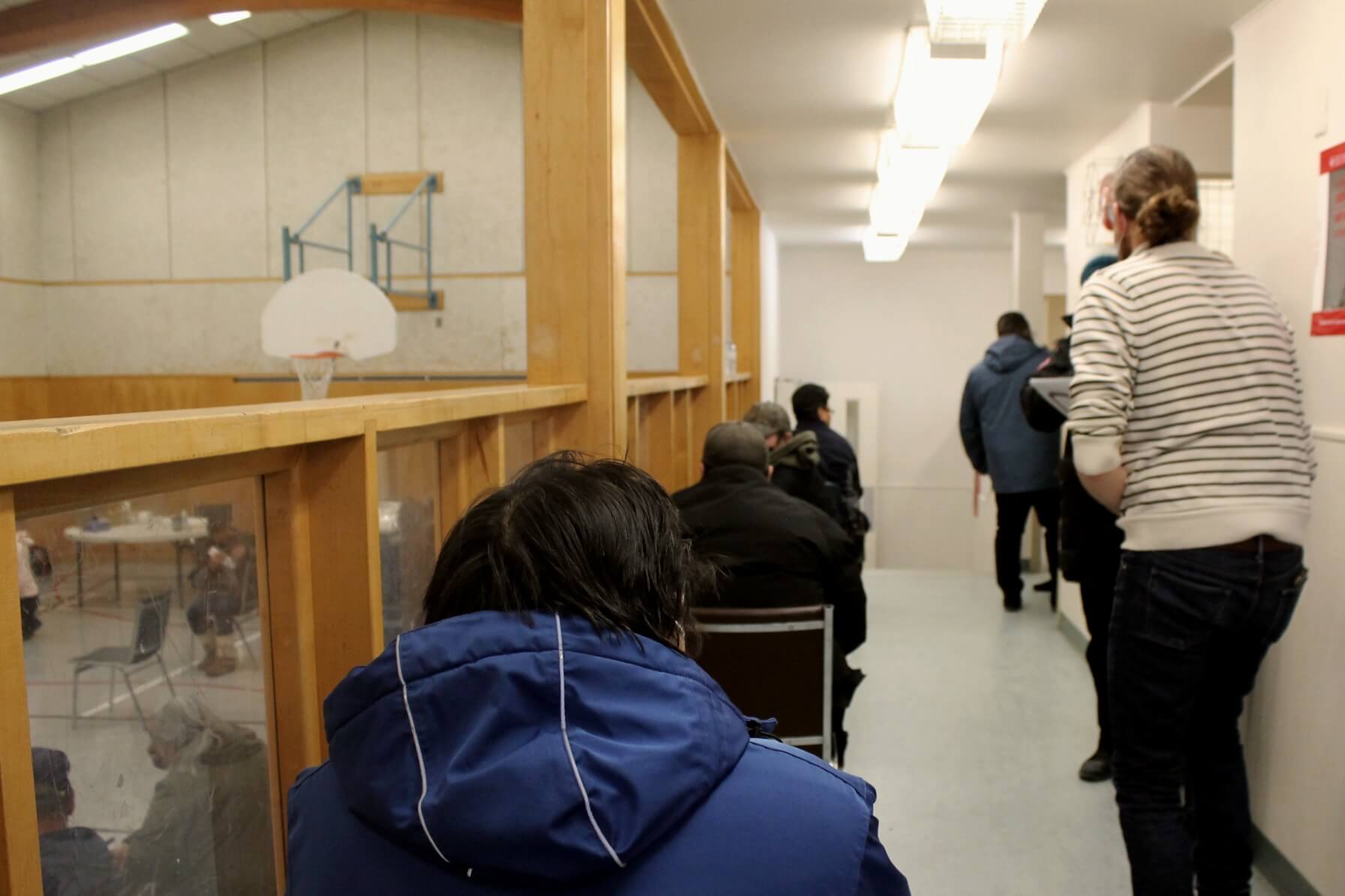
Dettah residents wait in line to receive their dose of the vaccine. (Photo by Bailey Moreton/MyTrueNorthNow.com.)

Green said vaccine take-up had been progressing, but was still low in some communities, ranging from 40 per cent to above 70 per cent depending on the community. Uptake was particularly low among younger adults aged 18 to 34, with less than half receiving a dose of the vaccine so far, according to Green.

In total, around 58 percent people have received their first dose of the Moderna COVID-19 vaccine, with 36 percent having received their second dose.

“At this point, it’s fair to say that there is no region or community in the NWT that’s met our target of vaccinating 75 percent of the population,” said Green.

But Green said the Office of the Chief Public Health Officer would be reviewing the GNWT’s Emerging Wisely Plan, which could see some COVID-19 restrictions lifted on a community-by-community basis depending on the rate of people vaccinated in a community.

MLA for Kam Lake Caitlin Cleveland said while communities shouldn’t be pitted against each other, making sure residents in one community aren’t suffering for low vaccine uptake in another community is a good idea.

“Not to put people against one another, but we will have different success at different points in time. I think it’s valuable to be able to look at this from a community-by-community basis, and not strictly an NWT-wide basis,” she said.


Green said restrictions within the NWT would be lifted first, which could include loosening restrictions on business capacity, summer music festivals, family gatherings and weddings.


Bailey Moreton
Bailey Moreton
Bailey is new to the north, arriving from Ottawa where he studied journalism at Carleton University. He has worked for newspapers in Halifax, Windsor, and Ottawa. He came to the north hoping to see polar bears. He will settle for a bison. If you have a tip, send it to 905 252-9781, or [email protected].

Continue Reading

You may also like


cjcd Now playing play

- Advertisement -

Related Articles

- Advertisement -

Latest News

Tuktoyaktuk RCMP lay charges in bootleg liquor investigation

Tuktoyaktuk RCMP are laying charges following an investigation into liquor bootlegging earlier this week.

Youth engage with Tłı̨chǫ language in unconventional immersive spaces

While in-person On the Land learning continues to be central to Tłı̨chǫ language revitalization, the Tłı̨chǫ language division is looking at ways to engage with youth through new immersive platforms, like virtual spaces, that honour history and traditions. Danielle Dacanay with the Tłı̨chǫ Government’s Language Division emphasized that virtual resources are supplements to learning the language in the traditional way, they are not a replacement for it.

New microgrant stream wants youth to plant language seeds outside school

“100 youth projects wanted in French,” a new microgrant program wants youth to plant language learning seeds outside school. A network of action-research teams in Canada, other parts of North America, Africa and Europe is launching a youth grant stream to support French language engagement outside of conventional spaces. Youth across the country aged 14 to 30 are eligible for 100 microgrants in support of grassroots initiatives as part of this program run by the Dialogue Network.

Water testing at another Yellowknife school confirms elevated lead and copper

Testing at another school site in the city of Yellowknife showed elevated levels of lead and copper in water present in some of its drinking taps. Earlier this month, testing showed four other school buildings in Yellowknife and a school in Behchokǫ̀ had elevated levels of both copper and lead in water. Since comprehensive testing of schools across the territory began this fall, 28 school sites out of 34 announced to date have tested positive for elevated levels of lead.

Testing at more NWT buildings confirms lead in water

Fort Smith officials said water testing at municipal buildings has confirmed the presence of lead. According to the announcement, water samples at the Town Hall, the Fire Hall, and the Municipal Services Building continue to show elevated levels of lead.