
It’s been an intense start to the NWT’s wildfire season, and if current weather patterns persist, things might not get better anytime soon.
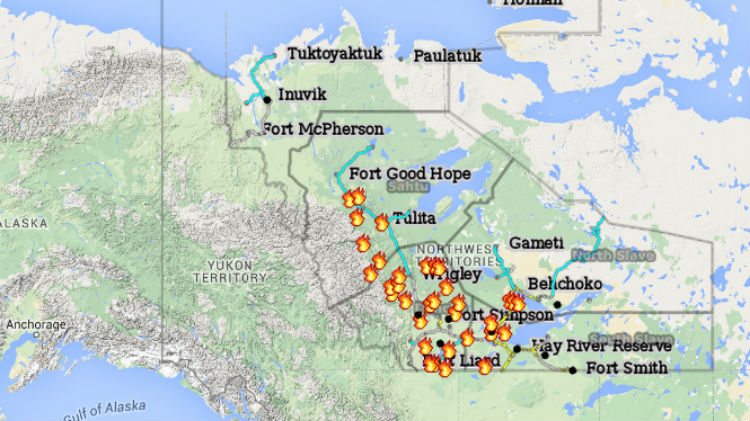
As of Thursday afternoon, 45 fires had been reported across the NWT. By this time last year, there were only four.
Richard Olsen, the territory’s manager of fire operations, told Moose FM the area of burnt land is already three times larger than the average year at this time.
According to the NWT’s current wildfire situation report, more than 40,000 hectares of land have been affected by fires so far.
Extremely dry conditions and lightning are to blame for a majority of the fires but a number have also been caused by humans.
Read: Airport Brush Fires As Burning Ban In Yellowknife Takes Effect
“Conditions are quite dry,” said Olsen. “There’s been a little bit of a reprieve in some areas from light rain that’s gone through but the majority of areas are still experiencing cooler but very dry conditions.”
Those conditions are certainly present in Yellowknife and Hay River – where fire bans have been implemented in the past week.
The fire danger for both communities is listed as extreme and little, if any, precipitation is forecast in the coming week.
Olsen says 40 firefighters are actively working on wildfires in the territory. The territorial government is also looking at getting some out-of-territory assistance.
“We’re looking at bringing in some fire behaviour specialists and some value protection specialists to help us take a really good look at some of these fires that may, in future, pose a risk to values,” he said.
Read: NWT Highway 3 To Close Between Fort Providence And Behchoko
At the moment, Olsen says fire crews are concentrating most of their efforts in the Deh Cho region, where 24 fires have already been reported this season.
Crews are also busy 60 kilometers south of Behchoko, where a wildfire east of Highway 3 has forced officials to close the route between Behchoko and Fort Providence for at least 12 hours on Friday to conduct a burnout operation.
The fire is roughly 5,000 hectares in size. Smoky conditions are expected in the area for the next couple of days.
We’ll provide updates on road conditions as we receive them.
To report smoke or fire in the forest, call 1-877-NWT-FIRE.
#NWTHwy3 CLOSING from Edzo & Fort Prov at 10am Fri May 29th for #NWTfire . 12hr closure expected. Hwy updates as info is available.
— GNWT/GTNO Infrastructure (@GNWT_INF) May 28, 2015