
Income check means seniors miss out on public housing: MLA

MLA for Thebacha Frieda Martselos says factors other than income should be considered when deciding whether seniors should be granted public housing, according to one MLA.

Martselos spoke in the Legislative Assembly on Tuesday, saying some seniors who may be above the income threshold for accessing public housing have other factors, like dependents, which mean they can’t actually afford housing.

“We need to re-evaluate how we help seniors find suitable housing for their situations,” she said. “It cannot be just about income. As I said last month, we need to consider something like a universal flat rate for all seniors in public housing.”

There are around 2,400 public housing units throughout the territory.

There were more than 900 people on the waitlist for public housing in 2019.

The cost of living in the NWT varies significantly between communities. 

The NWT Housing Corporation sets the Core Need Income Threshold (CNIT) for each community — which determines the amount of money a household would need to make to be able to rent or own a house on the private market.
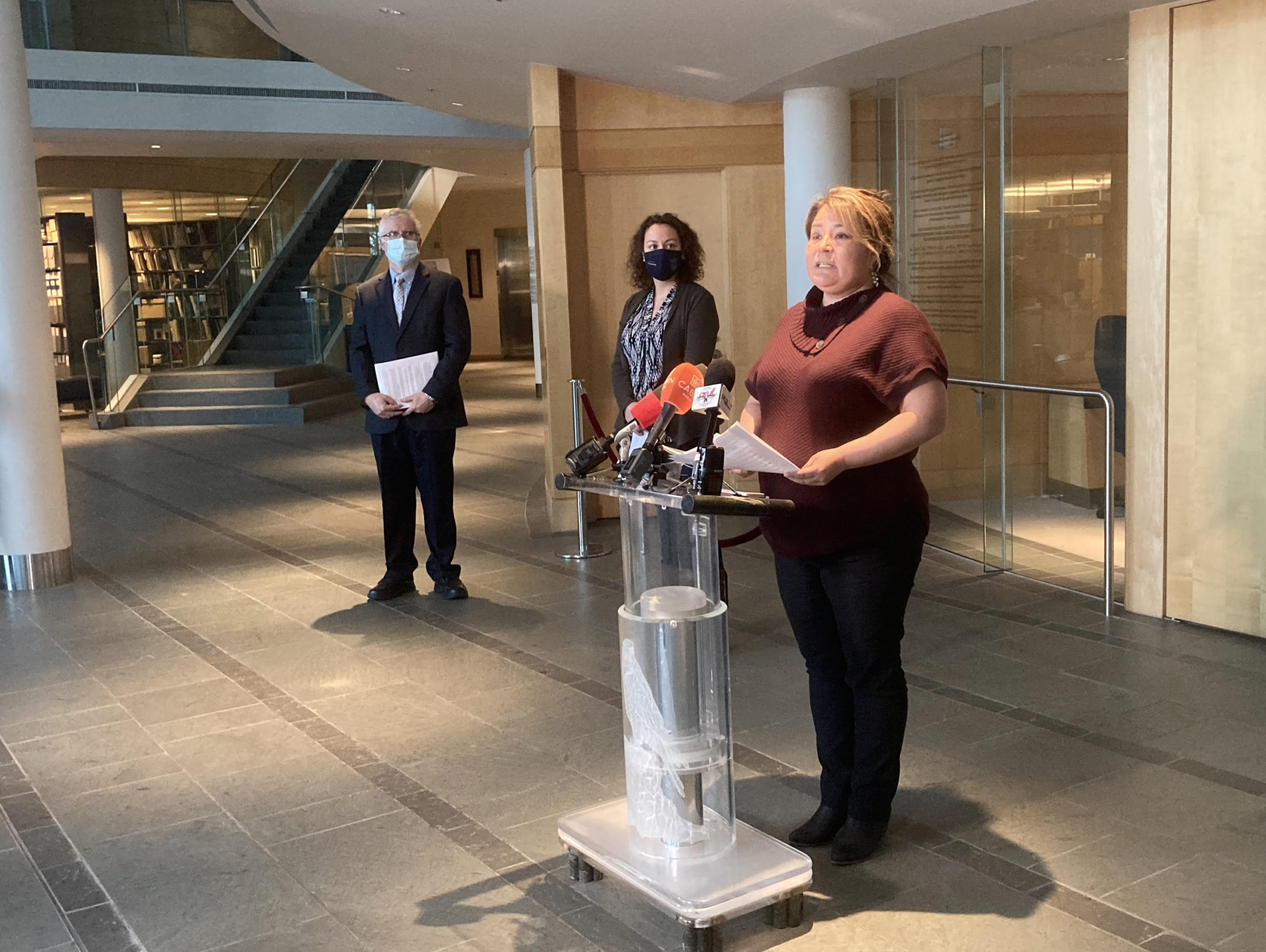
Housing minister Paulie Chinna. (Photo by Bailey Moreton/100.1 True North FM.)

Housing is considered affordable when it costs below 30 per cent of a household’s monthly income to rent it, as long as it has enough bedrooms for the number of people living there.

The NWT Community Housing Needs Survey in 2004 found that 16 percent of all NWT households, around 2,260 households, were below the income threshold and in need of housing assistance.

That’s higher than the national average, which was at 14 percent based on 2001 Census data

However, if Yellowknife and the regional centres of Inuvik, Hay River, and Fort Smith are removed from the survey results, the remaining 30 smaller NWT communities have 30 percent of households in core need.

Minister Responsible for the NWT Housing Corporation Paulie Chinna pointed to the building of more senior housing and the lifting of the requirement for land tenure and insurance for private homeowners as helping meet seniors housing needs.

But Chinna wouldn’t commit to removing the Core Need Income Threshold for seniors, but said it is something she will discuss within her department. 

The thresholds are reviewed and updated every two years, with new CNITs set to be implemented April 1, 2021.

Chinna added she would like to see more creativity in meeting residents’ housing needs from the NWT Housing Corporation.


Bailey Moreton
Bailey Moreton
Bailey is new to the north, arriving from Ottawa where he studied journalism at Carleton University. He has worked for newspapers in Halifax, Windsor, and Ottawa. He came to the north hoping to see polar bears. He will settle for a bison. If you have a tip, send it to 905 252-9781, or [email protected].

Continue Reading

You may also like


cjcd Now playing play

- Advertisement -

Related Articles

- Advertisement -

Latest News

Yellowknife’s Leah McShane shines bright as Loran 2026 Scholar

Leah McShane, a Yellowknife high school student, was just named a Loran Scholar for 2026, out of more than 5,400 applicants across the country. The student from École Sir John Franklin High School made it through four selection rounds to receive the award. “With a little bit of work you can do anything you set your mind to,” said McShane, who hopes she can inspire more youth to follow their dreams.

Indigenous languages pilot program to launch at NWT Legislative Assembly

A new pilot program will connect fluent Indigenous languages speakers to interpreter roles at the N.W.T Legislative  Assembly. The pilot program will run from May 2026 to March 2027, with one applicant selected for each of the N.W.T.’s official Indigenous languages: Dene Kǝdǝ́ (North Slavey), Dëne Sųłıné (Chipewyan), Dene Zhatıé (South Slavey), Dinjii Zhuʼ Ginjik (Gwich’in), Inuinnaqtun, Inuktitut, Inuvialuktun andTłı̨chǫ.

GNWT reminds residents not to dump trash on public land

The Government of the Northwest Territories is reminding residents that dumping garbage, appliances, or construction materials on public land is harmful to the environment and to wildlife and is illegal under territorial legislation.  

GNWT says another school shows elevated lead in some water fixtures

A school in Behchokǫ̀ is the latest to receive test results showing elevated levels of lead in some water fixtures. So far, 28 tested school results have been announced to date, 23 have tested positive for elevated levels of lead in some of their drinking water fixtures. Robin Ferguson, Acting Assistant Deputy Minister at the Department of Infrastructure has said the GNWT plans to test more public buildings once school testing is completed.

Climate plan draws from NWT Traditional Knowledge and meteorological data

Hay River, the Hay River Metis Nation, Kátł'odeeche and West Point First Nation are working on a climate action plan that combines local and Traditional knowledge and statistical data alongside meteorological records and forecasts.