



100.1 GO FM - We're Your Feel Good Pop Station

GWNT clamps down on unauthorized cabin building

The GNWT is clamping down on people building cabins on public land without permission.

Around 700 such cabins exist throughout the territory, mainly in the Yellowknife area.

Minister Shane Thompson, head of the land’s department says “squatting” on public lands has been a problem for decades and something the Department of Lands has been working on since 2014 when the department was established.

“We’re getting tough on those who are breaking the law, and who have no legal right or authorization to build on top of [the] land, but we will need to follow due process and do it right,” said Thompson.

Cabins built before April 1, 2014, will be evaluated on a case-by-case basis to determine possible eligibility for tenure — if the structures do not pass the evaluation, enforcement measures including removal of the structures can follow.
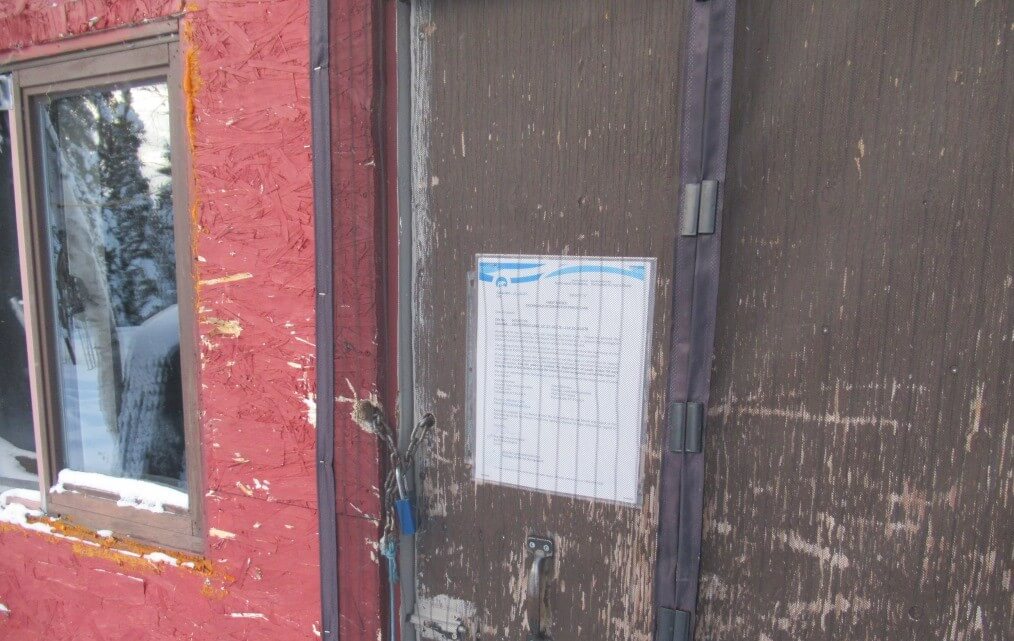
A notice issued on an illegal cabin. (Supplied by Executive and Indigenous Affairs.)

If people are eligible, they can sign leases to keep their cabins on public land.

Thompson said despite some of these cabins potentially being people’s only form of housing, removal of the structures would still proceed if they were found to be breaking the rules.

“First and foremost, we can’t be making exceptions to how we deal with it. It’s unfortunate they may just be their only home, but if it’s not within the rules and regulations then we still need to enforce our and be consistent,” said Thompson.

Ridgely added the enforcement is focused on cabins outside built-up communities, so it is less likely people will have nowhere else to go.

Enforcement staff surveys and aerial photography will help the GNWT establish when a cabin was built, according to Gina Ridgely, manager of sustainability with the Department of Lands.

Cabins that may be owned by Indigenous occupants who are exercising their asserted or established Aboriginal or treaty rights, will be allowed and referred to as ‘potential rights-based cabins. 

The GNWT is working with Indigenous governments to confirm which cabins are potential rights-based cabins

Since 2014, the GNWT has removed 17 cabins, but Blair Chapman, Assistant Deputy Minister of Operations, said the territorial government hopes to have posted notices to all the cabins within two years.


Bailey Moreton
Bailey Moreton
Bailey is new to the north, arriving from Ottawa where he studied journalism at Carleton University. He has worked for newspapers in Halifax, Windsor, and Ottawa. He came to the north hoping to see polar bears. He will settle for a bison. If you have a tip, send it to 905 252-9781, or [email protected].

Continue Reading

You may also like


cjcd Now playing play

- Advertisement -

Related Articles

- Advertisement -

Latest News

Report says lack of infrastructure causing high food prices in North

According to data collected by four Canadian universities for the Food Price Report, families across the country will spend an additional 4 to 6 per cent on food costs this year. Researchers from Dalhousie University, the University of British Columbia, the University of Saskatchewan and the University of Guelf, found food prices in the Northern territories are two to four times even higher compared to prices in urban cities of the south.

An Indigenous man last seen in Hay River area is missing

Police in Hay River say that an Indigenous man is missing from the community and are asking the public for assistance to locate him.

“Temporary” reduced public service hours in YK and Behchokǫ̀ begin today

The GNWT is reducing office hours including at the department of Education, Culture and Employment in the North Slave Regional and Community Service Centres in Yellowknife and Behchokǫ̀. While officials with the department say the reduced hours are currently temporary, they added it may become permanent.

GNWT examining feasibility of hosting 2035 Winter Olympic Games

The GNWT is considering whether to submit an official bid for the 2035 Winter Olympic Games, currently estimated to require an investment of $30 million.

Walk to Tuk 2026 honours and celebrates traditional Indigenous pathway

“Originally wasn't called Walk to Tuk, that name came about organically. People just started to call it Walk to Tuk and the name stuck,” says Tim Van Dam, a main organizer of the event. The initiative brings together individuals, schools, workplaces, families, and community groups across the territory to stay active by conceptually walking the length of the Big River, a distance of 1658 km from Zhatıé Kų́ę́ / Fort Providence to Tuktuuyaqtuuq / Tuktoyaktuk.



