



100.1 GO FM - We're Your Feel Good Pop Station

GWNT clamps down on unauthorized cabin building

The GNWT is clamping down on people building cabins on public land without permission.

Around 700 such cabins exist throughout the territory, mainly in the Yellowknife area.

Minister Shane Thompson, head of the land’s department says “squatting” on public lands has been a problem for decades and something the Department of Lands has been working on since 2014 when the department was established.

“We’re getting tough on those who are breaking the law, and who have no legal right or authorization to build on top of [the] land, but we will need to follow due process and do it right,” said Thompson.

Cabins built before April 1, 2014, will be evaluated on a case-by-case basis to determine possible eligibility for tenure — if the structures do not pass the evaluation, enforcement measures including removal of the structures can follow.
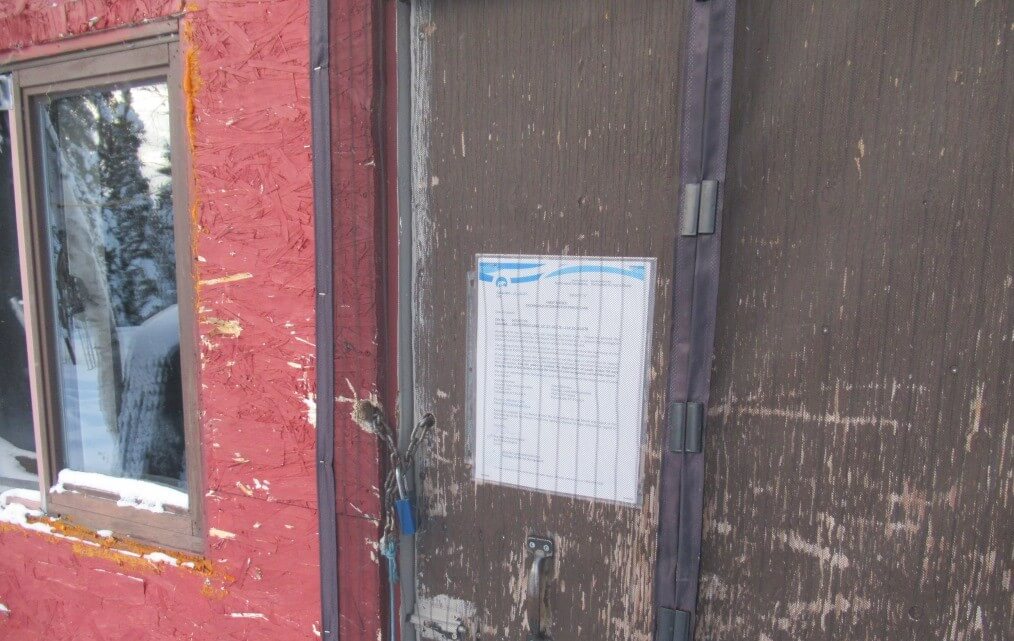
A notice issued on an illegal cabin. (Supplied by Executive and Indigenous Affairs.)

If people are eligible, they can sign leases to keep their cabins on public land.

Thompson said despite some of these cabins potentially being people’s only form of housing, removal of the structures would still proceed if they were found to be breaking the rules.

“First and foremost, we can’t be making exceptions to how we deal with it. It’s unfortunate they may just be their only home, but if it’s not within the rules and regulations then we still need to enforce our and be consistent,” said Thompson.

Ridgely added the enforcement is focused on cabins outside built-up communities, so it is less likely people will have nowhere else to go.

Enforcement staff surveys and aerial photography will help the GNWT establish when a cabin was built, according to Gina Ridgely, manager of sustainability with the Department of Lands.

Cabins that may be owned by Indigenous occupants who are exercising their asserted or established Aboriginal or treaty rights, will be allowed and referred to as ‘potential rights-based cabins. 

The GNWT is working with Indigenous governments to confirm which cabins are potential rights-based cabins

Since 2014, the GNWT has removed 17 cabins, but Blair Chapman, Assistant Deputy Minister of Operations, said the territorial government hopes to have posted notices to all the cabins within two years.


Bailey Moreton
Bailey Moreton
Bailey is new to the north, arriving from Ottawa where he studied journalism at Carleton University. He has worked for newspapers in Halifax, Windsor, and Ottawa. He came to the north hoping to see polar bears. He will settle for a bison. If you have a tip, send it to 905 252-9781, or [email protected].

Continue Reading

You may also like


cjcd Now playing play

- Advertisement -

Related Articles

- Advertisement -

Latest News

Post-Trump talk, Minister Wawzonek says “good news coming from North”

“I think all Canadians are probably concerned about it to a degree,” says Northwest Territories Infrastructure Minister and Deputy Premier Caroline Wawzonek, who adds that while any formal response to recent threats from the U.S. to annex Canada will come from the feds, it's an important time for everyone across the North to “assert sovereignty.” By “positioning the North to be economically strong” this will also benefit the rest of the country, said Minister Wawzonek.

École William McDonald and N.J. Macpherson School in clear, say officials

The Office of the Chief Public Health Officer issued an announcement today that Health Orders placed at École William McDonald Middle School and N.J. Macpherson School last year have been lifted. Officials reported that the lead levels at the schools no longer exceed Health Canada guidelines.

GNWT says it’s time to “rename” sites to reflect YK culture and history

The renaming may be a reflection of a changing landscape in the city. With more development coming North, Indigenous leaders and allies are taking part in a growing dialogue of honouring and acknowledging living histories that go trace back to time immemorial. The issue of renaming has become a hot topic for Yellowknifers from streets on the city’s landscape like Franklin Ave to waterbodies like the Great Slave Lake.

Missing Persons Act comes into force

The Missing Persons Act, a new piece of legislation that aims to assist police in investigating missing persons in the Northwest Territories, has come into force.

Yellowknife and NSMA sign memorandum on copper recycling

North Slave Métis Alliance (NSMA) and the City of Yellowknife signed a Memorandum of Understanding today regarding the collection, processing, and recycling of waste copper.



