



100.1 GO FM - We're Your Feel Good Pop Station

How is the territory supporting RCMP?: MLA

RCMP officers need more support and training, according to a report a Hay River MLA cited during his comments in the Legislative Assembly.

Rocky Simpson, the MLA for Hay River South, asked the Minister for Justice on Tuesday how his department is supporting RCMP officers, amid “bad press” for police elsewhere.

“In my five years in this Assembly, no one has ever said they want less RCMP,” said R.J. Simpson in response. “Every community, every Member says they want more RCMP in the community and that they appreciate their efforts.”

The NWT has the highest concentration of RCMP officers in Canada. There are 416 RCMP officers per 100,000 people. The next highest is Nunavut with 354 per 100,000.

A 2019 Auditor General report into the RCMP’s training for active shooter situations found RCMP officers were inadequately prepared.
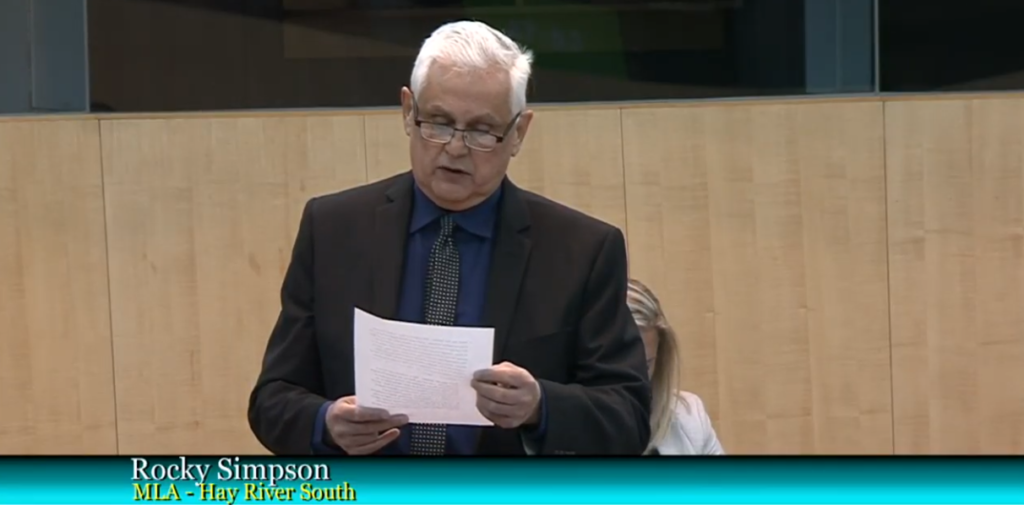
Simpson asked what the GNWT is doing to support RCMP during a period of “bad press” for the police. File photo.

“RCMP officers don’t always have the equipment and the training they need to protect themselves and the public,” read the report.

The police have been put under a spotlight in recent months, with Black Lives Matter protests in the U.S calling attention to systemic racism within police culture. 

The RCMP has not been above controversy, with questions over their actions in Wet’suwet’en pipeline protests and more recently their handling of confrontation between Mik’maq fishers and non-Indigenous lobster fisherman in Nova Scotia.

NT RCMP spokesperson Julie Lalonde said there are regular conversations between the GNWT, the RCMP and communities about improving training for officers.

“The RCMP is built on a foundation of well-trained police officers and as the police of jurisdiction in the NWT — ongoing training remains a priority,” she said in an email.

“The NT RCMP is committed to continue to work with our partners to deliver professional, efficient and effective police service in the Northwest Territories.”

The GNWT’s justice department increased the funding for RCMP training in 2019-20 by over $200,000 annually to improve the training offered to RCMP officers. The total spent on training was $323,000.

When it comes to making changes in the future to training or the number of officers, a number of factors are considered, including sustainability, calls for service, community population and infrastructure requirements, according to Ngan Trinh, spokesperson for the Department of Justice.

“The RCMP have significant levels of mandatory training to maintain, and the GNWT has supported them through our contract to ensure they have what they need,” said Trinh. “A large portion of the Department of Justice budget goes to policing.”


Bailey Moreton
Bailey Moreton
Bailey is new to the north, arriving from Ottawa where he studied journalism at Carleton University. He has worked for newspapers in Halifax, Windsor, and Ottawa. He came to the north hoping to see polar bears. He will settle for a bison. If you have a tip, send it to 905 252-9781, or [email protected].

Continue Reading

You may also like


cjcd Now playing play

- Advertisement -

Related Articles

- Advertisement -

Latest News

Alternatives North suspects regulatory capture in ITI

Alternatives North believe they have uncovered evidence of the ‘regulatory capture’ of the GNWT Department of Industry Trade and Investment (ITI) by the mining industry, specifically regarding the regulatory policies surrounding the Mineral Resources Act. 

Relentless Indigenous Woman talks languages, “literally” changing world

Dr. Candace Manitopyes, aka The Relentless Indigenous Woman, is working with Elders and Language Keepers in the North and across Turtle Island on relaunching an Indigenous languages program. Dr. Manitopyes says there is an urgency to support Indigenous language learning, especially for Northern First Nations communities, where culturally responsive community rooted resources are even more scarce.

New generation of Indigenous languages speakers celebrated in the NWT

“The language is who we are. Language is our Elders. Language is what makes us who we are,” said Paul Andrew, who emceed a special gathering in Yellowknife that included mentors and apprentice Indigenous language learners, their families, organizers and community leaders. This year’s cohort engaged in learned the languages of Gwich’in, Tłı̨chǫ, Inuvialuktun, Inuinnaqtun, Inuktitut,Dene Kede, Dene Zhatıé, Nêhiyawêwin, Dëne Sųłıné and Wı̀ılı̀ıdeh. 

NWT services to be made accessible in Indigenous languages, says GNWT

The territorial government will soon begin offering all services in each of the 11 official languages including the nine Indigenous languages of Dinjii Zhu Ginjik (Gwich’in), ᐃᓄᒃᑎᑐᑦ (Inuktitut), Inuvialuktun, Inuinnaqtun, Dene Kǝdǝ́/ Sahtúot'ı̨nę Yatı̨ (North Slavey), Dene Zhatıé (South Slavey), Tłı̨chǫ, Dëne Sųłıné (Chipewyan) and Nëhiyawëwin (Cree). Previously, the services had been available in English and French only.

Support and funding for “Language Cafes” to launch this spring

The NWT Literacy Council has started a new funding program to help support Indigenous language revitalization. Kathryn Barry Paddock, Executive Director of the NWT Literacy Council made the announcement that the organization is promoting more funding and the creation of more accessible spaces for Indigenous language through "Language Cafe" events.



