100.1 GO FM - We're Your Feel Good Pop Station

Vikings meet Inuit in new Yellowknife sculpture exhibit

A new sculpture exhibit opens at Yellowknife’s Prince of Wales Northern Heritage Centre on Thursday.

Inuvialuit artist Abraham Anghik Ruben, a former Yellowknife resident, unveils his Aurora Borealis exhibit at a reception from 7pm.

Ruben says his work in the exhibit draws on the contact made between Viking and Inuit peoples a thousand years ago.

“Since 2004, I’ve been involved with the study of the Inuit and the Norse in Arctic Canada and Greenland,” Ruben told Moose FM.

“I’ve done extensive studies on Scandinavian and Germanic myths, legends, stories and sagas – especially the Bering Sea Inuit, who left their homelands with the coming of an Arctic warming period, culminating in their meeting with the Vikings in Greenland about a thousand years ago.

“There was a time when both the Inuit and the Vikings carried and practised similar beliefs. They believed in the spirit of the place. They had a shared belief in the reverence of all living things – that all living things were imbued with a soul, that there was a protective spirit to a place.”

Event details: Aurora Borealis exhibit opening

Ruben lived in Yellowknife between 1975 and 1980, a period he describes as his “formative years” as a sculptor.

Prior to that, he learned his trade in Fairbanks, Alaska, having grown up in Paulatuk and Inuvik.Aurora Borealis sculpture
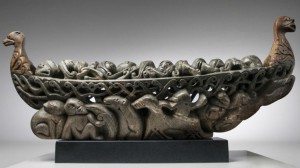
“I’ve spent the last 40 years basically on the road,” he told us. “I can say, with all honesty, that it’s only been in the last 10 years that I feel I’ve matured as an artist, that I’ve felt I have a grasp of what I’m doing.”

After a decade studying the beliefs of the Vikings and Inuit, Ruben feels they have a message for people in the 21st Century.

“The sculpture in the exhibition deals with Viking mythology, legends, the North Atlantic sagas, and the Inuit myths and legends they brought with them from Alaska to Greenland,” he said.

“What I see coming full circle today is the climatic shifts that caused that migration, a thousand years ago, are unraveling themselves again today. Changing our climate is going to hit harder, faster, and longer, and we’re living it.

“The stories that took place a thousand years ago still resonate today.

“We should be able to look back and draw from those traditions, because it’s those traditions and ancient beliefs that in the end we might have to come back to, to save ourselves.”


Ollie Williams
Ollie Williams
Hello! I'm the one with the British accent. Thanks for supporting CJCD. To contact me, you can email me, find me on Twitter or call (867) 920-4663.

Continue Reading

You may also like


cjcd Now playing play

- Advertisement -

Related Articles

- Advertisement -

Latest News

Inuit Nunangat University to begin regional knowledge centre site selection

Following the selection of Arviat, Nunavut, as the site of Inuit Nunangat University’s main campus, the process to choose regional knowledge centres and satellite campuses across Inuit Nunangat is underway. Arviat, with a population of about 3,000, is Nunavut’s third-largest community and has one of the highest proportions of youth in the country.

Premier supports “dual use” aspects of country’s first “Defence Industrial Strategy”

The federal government announced the strategy Monday, describing it as the country’s first national defence industrial strategy. Simpson said those elements are particularly relevant to the North. He said equipment and technology systems intended for use in the Arctic should be tested in the territory’s northern climate and developed in partnership with northern governments, Indigenous rights holders and communities.

Nominee Program opens up for 2026

The Northwest Territories Nominee Program will be opening applications for the employer-driven and francophone streams starting March 9 at 9am.  

Yellowknife Fire Fighter Association campout fundraiser to be held this weekend

The Yellowknife Fire Fighter Association will be holding a campout this weekend on the roof of the Yellowknife CO-OP to raise funds and awareness for Muscular Dystrophy Canada. 

Search continues for ways to deal with 200,000 tons of arsenic dust at Giant Mine

Scientists presented projects for a more permanent solution to hundreds of thousands of tons arsenic dust from the mine. One method uses local beer to fuel a transformation of the toxic dust, while another tries to turn it into glass. Another proposed method looks at turning the dust into a highly sought commodity known as metallic arsenic. Additional proposals look whether robotic technology could allow crews to virtually pilot the extraction of the dust while “sipping coffee” from a distance.