The Government of Nunavut is reducing retail fuel prices on diesel and gasoline

It will soon cost you less to fill your gas tank in Nunavut.

The Government of Nunavut (GN) is reducing retail fuel prices on diesel and gasoline products across the territory, effective January 12, 2020.

Consumers in all Nunavut communities will see the retail prices for all diesel products and gasoline fall by 4 cents per litre, before tax.

In Iqaluit, the cost will be reduced by an additional 5 cents per litre, before tax, on diesel fuel and gasoline, for a total cost reduction of 9 cents per litre.

The additional price reductions in Iqaluit are intended to reduce the gap between what consumers pay in Iqaluit compared to other communities, where prices are lower.

“The GN is committed to providing Nunavummiut with high quality fuel products that are suited for our Arctic environment, at the best possible price,” the Minister of Community and Government Services Lorne Kusugak said. “Thanks to the diligence of our Petroleum Products Division (PPD) in implementing their early purchase policies, we are able to provide these substantial cost reductions to Nunavummiut.”

The reductions in fuel prices reflect an overall decline in crude market prices in 2019.
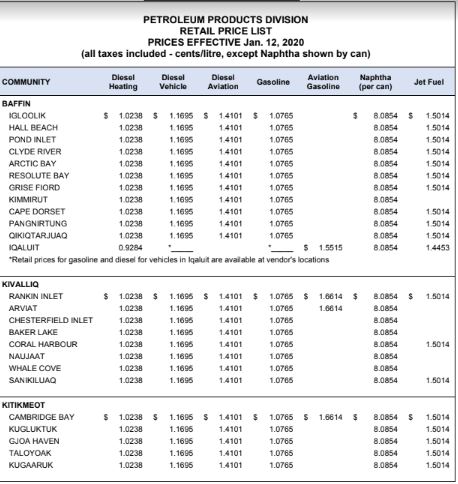
PPD was able to capitalize on advantageous crude prices in international markets and secure its 2019 diesel and gasoline requirements at costs 11 to 15 per cent lower than in 2018.

Nunavut remains one of the lowest-cost jurisdictions in Canada for purchasing fuels.

[email protected]

Twitter.com/artcgreen

Arthur C. Green
Arthur C. Green
Arthur C. Green is from Whitbourne Newfoundland and graduated from the CNA Journalism Program. Arthur also studied Business Marketing and Political Science at Memorial University in Essex England and St. John's Newfoundland. Green has worked as a spot news photographer/journalist with such news organizations as CBC, CBC Radio, NTV, Saltwire and Postmedia in Alberta.

Continue Reading

You may also like


cjcd Now playing play

- Advertisement -

Related Articles

- Advertisement -

Latest News

FS016 gets needed rainfall, “drastically” reducing fire activity

FS016 received up to 25 millimetres of rain, "drastically " reducing fire activity on Thursday. The wildfire remains adjacent to Liidlii Kue and Fort Simpson, covering an area over 36,380 hectares according to the latest report by Wildland officials Thursday evening.

Amber alert sounded in N.W.T. involving two children last seen in B.C.

An amber alert has sounded in the territory involving two children last seen in B.C. The alert was first issued on Wednesday in Alta. and has been expanded into the neighbouring territories and provinces.

Herring gull found with bird flu in Ft Smith

A case of bird flu has been identified in Fort Smith. The case of Highly Pathogenic Avian Influenza (HPAI) was identified in a herring gull. According to an advisory issued this afternoon by the Environment and Climate Change, while the disease is highly infectious among birds, transmission risk to humans remains very low.

N.W.T., Nunavut and Man. forecast to face “highest fire danger” this season

Emergency Management Minister Eleanor Olszewski says that fire danger is anticipated to be highest in the N.W.T., Nunavut and Man. this season. The minister added that recent rains in the west are forecasted to bring relief. “Modelling indicates that in July, fire danger is expected to remain the highest across the Northwest Territories, Nunavut and northern Manitoba and areas surrounding the Hudson Bay, with elevated potential for fires in northern Ontario and Quebec."

GNWT scientists say Mackenzie and Great Slave returning to pre 2023 levels

Scientists with the GNWT’s Environment and Climate Change department say water levels are showing signs of recovery. Data collected over June and early July showed generally higher than levels for most large lakes and rivers in the territory compared to last year and previous years going back to 2023. Data showed that the Mackenzie River’s has returned to average and above average levels after a dramatic decline that saw the cancellation of the barge in 2024.