100.1 GO FM - We're Your Feel Good Pop Station

Harry Potter tried for murder in Yellowknife court

In the matter of Her Majesty the Queen versus Harry Potter, the jury needed only 10 minutes to deliberate.

The boy wizard faced a charge of second-degree murder inside Yellowknife’s courthouse on Thursday, watched by more than 30 grade nine students from Sir John Franklin High School.

Lawyers and a judge staged the mock trial to show students how the territory’s real legal system operates.

The 90-minute trial saw Potter accused of murdering Professor Quirinus Quirrell in events approximating those of JK Rowling’s first book.

The prosecution called three witnesses: Rubeus Hagrid, Severus Snape, and an alleged mass murderer and dark lord who cannot be named for evil reasons.

Potter, taking to the stand himself, admitted he had “blacked out”, blaming that for his hazy recollection of the precise manner of Quirrell’s death.

Given the mess of conflicting testimony from the prosecution witnesses, it was no surprise when an impromptu jury – plucked from the onlooking students – swiftly acquitted Potter.

“I’m a big, big fan of Harry Potter’s,” jury foreman Pyper Ann Legge, 15, slightly rashly admitted to Moose FM at the trial’s conclusion.

“It was really interesting and fun. I thought it was cool.”
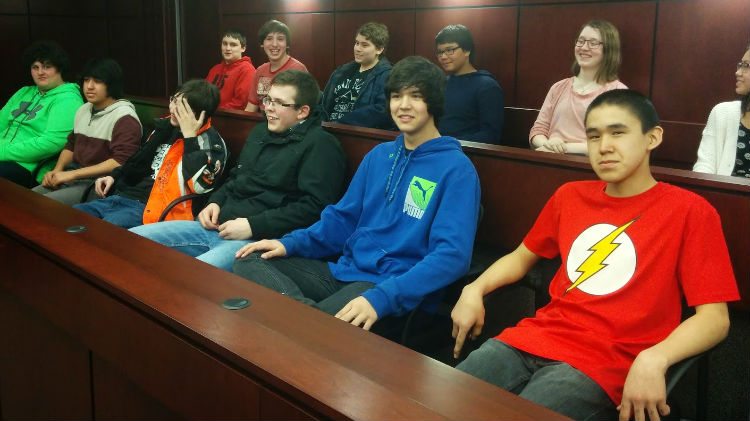
Jurors from Sir John Franklin High School
Jurors from Sir John Franklin High School.

Legge said all but two of the jurors had immediately been in favour of a not-guilty verdict.

The remaining two had been persuaded by Legge’s encyclopedic knowledge of the Harry Potter series – introducing extraneous evidence that might, ordinarily, be grounds for a Crown appeal.

“There were a couple of things, facts from the films, that kind-of diverged,” she said.

“Also, Harry Potter was 10 years old when that took place [in the book and film]. I’m imagining they aged him up a bit.

“All of the witnesses supporting that Harry murdered Quirrell kept on changing their stories and making mistakes in their stories.”

Nick Leeson, the chair of the Young Lawyers’ Committee for the local branch of the Canadian Bar Association, helped to organize the trial as part of Law Week.

“The purpose of Law Week is to get rid of some of the mystique and mystery that goes along with the legal system, and help to spread public knowledge of the legal system as far as we can,” Leeson told Moose FM.

“This is an opportunity to introduce the students to the legal system and see how a criminal trial goes, as realistically as possible, without actually going to a real trial here.

“[Harry Potter] is something that all young people understand – and I’m not embarrassed to say older people know and love it, too. It makes it that much more exciting for the students, and at the same time it’s a learning opportunity.”


Ollie Williams
Ollie Williams
Hello! I'm the one with the British accent. Thanks for supporting CJCD. To contact me, you can email me, find me on Twitter or call (867) 920-4663.

Continue Reading

You may also like


cjcd Now playing play

- Advertisement -

Related Articles

- Advertisement -

Latest News

Alternatives North suspects regulatory capture in ITI

Alternatives North believe they have uncovered evidence of the ‘regulatory capture’ of the GNWT Department of Industry Trade and Investment (ITI) by the mining industry, specifically regarding the regulatory policies surrounding the Mineral Resources Act. 

Relentless Indigenous Woman talks languages, “literally” changing world

Dr. Candace Manitopyes, aka The Relentless Indigenous Woman, is working with Elders and Language Keepers in the North and across Turtle Island on relaunching an Indigenous languages program. Dr. Manitopyes says there is an urgency to support Indigenous language learning, especially for Northern First Nations communities, where culturally responsive community rooted resources are even more scarce.

New generation of Indigenous languages speakers celebrated in the NWT

“The language is who we are. Language is our Elders. Language is what makes us who we are,” said Paul Andrew, who emceed a special gathering in Yellowknife that included mentors and apprentice Indigenous language learners, their families, organizers and community leaders. This year’s cohort engaged in learned the languages of Gwich’in, Tłı̨chǫ, Inuvialuktun, Inuinnaqtun, Inuktitut,Dene Kede, Dene Zhatıé, Nêhiyawêwin, Dëne Sųłıné and Wı̀ılı̀ıdeh. 

NWT services to be made accessible in Indigenous languages, says GNWT

The territorial government will soon begin offering all services in each of the 11 official languages including the nine Indigenous languages of Dinjii Zhu Ginjik (Gwich’in), ᐃᓄᒃᑎᑐᑦ (Inuktitut), Inuvialuktun, Inuinnaqtun, Dene Kǝdǝ́/ Sahtúot'ı̨nę Yatı̨ (North Slavey), Dene Zhatıé (South Slavey), Tłı̨chǫ, Dëne Sųłıné (Chipewyan) and Nëhiyawëwin (Cree). Previously, the services had been available in English and French only.

Support and funding for “Language Cafes” to launch this spring

The NWT Literacy Council has started a new funding program to help support Indigenous language revitalization. Kathryn Barry Paddock, Executive Director of the NWT Literacy Council made the announcement that the organization is promoting more funding and the creation of more accessible spaces for Indigenous language through "Language Cafe" events.