


100.1 GO FM - We're Your Feel Good Pop Station

Would you take on an ice road marathon? This trio did

“It was us and an ocean of ice.”

Three people have completed an ice road marathon in the Northwest Territories, raising funds for nutrition programs in northern communities.

Steve Thomas, Megan Rodel and Marc Lincoln completed the marathon along 42 kilometres of the ice road leading to the Gahcho Kué diamond mine.

“We were very fortunate. It was a bright, sunny, albeit cold day and we had the wind at our backs, with beautiful, pristine land around us,” said Thomas.

The chief financial officer of diamond mining giant De Beers Canada, Thomas was completing his second ice road marathon in a month, having previously taken on a similar run in northern Ontario.

“This was the second-loneliest marathon ever,” joked Thomas, who ran his first ice road marathon alone. “I was very pleased to have Megan and Marc in support.”

Asked where his sudden passion for long-distance ice-road running had come from, he replied: “I had a big birthday recently. Maybe I can put some of it down to a mid-life crisis.”

Thomas and Snap Lake mine employee Rodel ran the 42-kilometre route; Lincoln, who also works at Snap Lake, completed it by bike.
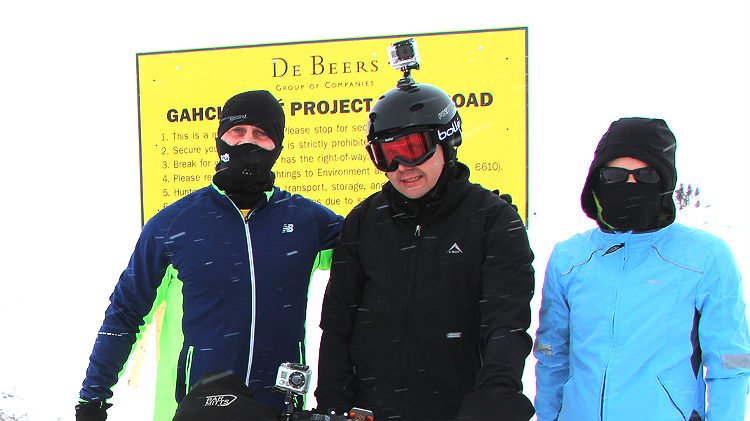
Marathon runners
Left-right: Steve Thomas, Marc Lincoln and Megan Rodel at the start of the ice road.

“We had a little snow on the ground so the traction wasn’t that bad, and we had a support vehicle driving ahead of us to make tracks,” said Rodel of her first ice road marathon.

What did she learn from her debut in these conditions?

“Basically, a change of clothes is positive,” she laughed. “We changed our clothes at about 25 kilometres. It’s nice to get out of the wet clothes and into something dry, you almost immediately feel better.

“A change of clothes at the end was also really, really great.

“It’s more in your mind than anything else. Keeping your mind focused on your surroundings, why you’re doing it, and putting one foot in front of the other.”

As of Tuesday, the trio’s marathon exploits had raised $14,749 for the Food First Foundation in the NWT.

The foundation runs nutrition programs in northern communities, where the cost and availability of food can be prohibitive.

“It’s obviously a very big concern for us,” Thomas told Moose FM.

“The notion that any child goes to school hungry is obviously something we don’t like the thought of, and we’ll do whatever we can to help.”


Ollie Williams
Ollie Williams
Hello! I'm the one with the British accent. Thanks for supporting CJCD. To contact me, you can email me, find me on Twitter or call (867) 920-4663.

Continue Reading

You may also like


cjcd Now playing play

- Advertisement -

Related Articles

- Advertisement -

Latest News

Inuit Nunangat University to begin regional knowledge centre site selection

Following the selection of Arviat, Nunavut, as the site of Inuit Nunangat University’s main campus, the process to choose regional knowledge centres and satellite campuses across Inuit Nunangat is underway. Arviat, with a population of about 3,000, is Nunavut’s third-largest community and has one of the highest proportions of youth in the country.

Premier supports “dual use” aspects of country’s first “Defence Industrial Strategy”

The federal government announced the strategy Monday, describing it as the country’s first national defence industrial strategy. Simpson said those elements are particularly relevant to the North. He said equipment and technology systems intended for use in the Arctic should be tested in the territory’s northern climate and developed in partnership with northern governments, Indigenous rights holders and communities.

Nominee Program opens up for 2026

The Northwest Territories Nominee Program will be opening applications for the employer-driven and francophone streams starting March 9 at 9am.  

Yellowknife Fire Fighter Association campout fundraiser to be held this weekend

The Yellowknife Fire Fighter Association will be holding a campout this weekend on the roof of the Yellowknife CO-OP to raise funds and awareness for Muscular Dystrophy Canada. 

Search continues for ways to deal with 200,000 tons of arsenic dust at Giant Mine

Scientists presented projects for a more permanent solution to hundreds of thousands of tons arsenic dust from the mine. One method uses local beer to fuel a transformation of the toxic dust, while another tries to turn it into glass. Another proposed method looks at turning the dust into a highly sought commodity known as metallic arsenic. Additional proposals look whether robotic technology could allow crews to virtually pilot the extraction of the dust while “sipping coffee” from a distance.


