
100.1 GO FM - We're Your Feel Good Pop Station

Outbreak declared in Inuvik after second person gets measles

A measles outbreak has been declared in Inuvik after it has been confirmed that a second person was infected with the virus.

This brings the number of people in the NWT with measles to two, both in Inuvik. The office of the chief public health officer declared the outbreak Wednesday, stating it is possible for people who are not immune to develop measles with the period of risk lasting until around March 26.

“At this time we do not expect other individuals outside of Inuvik to develop measles,” a public health advisory states.

For those in Inuvik who may be at risk, they are urged to monitor for symptoms including fever, runny nose, cough, red eyes or a rash starting on the face and spreading to the chest. Symptoms can develop from a week to 21 days after exposure to the virus.
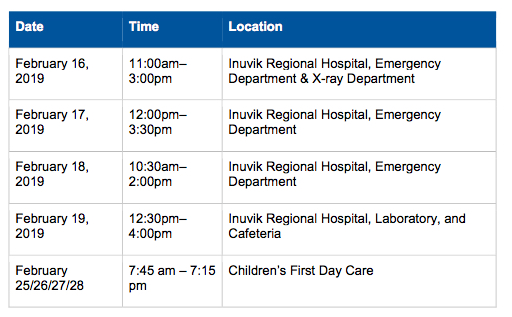
Locations and dates where people may have been exposed to measles. Department of Health and Social Services image

“If you develop symptoms, remain at home and call your health care provider immediately,” the advisory states. Calling ahead allows healthcare centres to prevent transmission of measles to other visitors.

The advisory states people are likely immune to the measles virus if they were born before 1970, born after 1970 aged 18 or older with one dose of measles vaccine, or are between one and 18 years old with two doses of measles vaccine.

If people want to confirm whether they, or their children, are immunized they should make an appointment with their local public health unit. For Inuvik residents, call 867-777-7246.

The health department called for anyone who is not immune to measles to contact their healthcare provider and review the option of being immunized.

Emelie Peacock
Emelie Peacock
News Reporter

Continue Reading

You may also like


cjcd Now playing play

- Advertisement -

Related Articles

- Advertisement -

Latest News

Four more schools test positive for elevated lead in a number of fixtures

Four more school buildings have tested positive for elevated levels of lead in drinking water in a number of the water fixtures at the facilities, according to the latest announcement by the territorial government. With 24 tested school results announced to date, 20 have tested positive for elevated levels of lead in some of their drinking water fixtures.

Alternatives North suspects regulatory capture in ITI

Alternatives North believe they have uncovered evidence of the ‘regulatory capture’ of the GNWT Department of Industry Trade and Investment (ITI) by the mining industry, specifically regarding the regulatory policies surrounding the Mineral Resources Act. 

Relentless Indigenous Woman talks languages, “literally” changing world

Dr. Candace Manitopyes, aka The Relentless Indigenous Woman, is working with Elders and Language Keepers in the North and across Turtle Island on relaunching an Indigenous languages program. Dr. Manitopyes says there is an urgency to support Indigenous language learning, especially for Northern First Nations communities, where culturally responsive community rooted resources are even more scarce.

New generation of Indigenous languages speakers celebrated in the NWT

“The language is who we are. Language is our Elders. Language is what makes us who we are,” said Paul Andrew, who emceed a special gathering in Yellowknife that included mentors and apprentice Indigenous language learners, their families, organizers and community leaders. This year’s cohort engaged in learned the languages of Gwich’in, Tłı̨chǫ, Inuvialuktun, Inuinnaqtun, Inuktitut,Dene Kede, Dene Zhatıé, Nêhiyawêwin, Dëne Sųłıné and Wı̀ılı̀ıdeh. 

NWT services to be made accessible in Indigenous languages, says GNWT

The territorial government will soon begin offering all services in each of the 11 official languages including the nine Indigenous languages of Dinjii Zhu Ginjik (Gwich’in), ᐃᓄᒃᑎᑐᑦ (Inuktitut), Inuvialuktun, Inuinnaqtun, Dene Kǝdǝ́/ Sahtúot'ı̨nę Yatı̨ (North Slavey), Dene Zhatıé (South Slavey), Tłı̨chǫ, Dëne Sųłıné (Chipewyan) and Nëhiyawëwin (Cree). Previously, the services had been available in English and French only.