
Yellowknife students rise above bullying

“Cyberbullying affects 42 per cent of Canadian youth each month.”

“Over 3.2 million students are victims of bullying each year, 64 per cent of the victims consider bullying a normal part of school life.”

“72 per cent of children witness bullying at school and only 40 per cent do something about it.”

“Researchers say that bullying usually ends within 10 seconds of an intervention of others. 26 per cent of teens have suicidal thoughts because of bullying.”

“Youth who are bullied suffer more headaches, stomach aches and cases of depression and anxiety. Mental health problems also tend to last until later in life.” 

These were some of the realities shared by William McDonald Middle School students at a Pink Shirt Day event at the Legislative Assembly Wednesday, organized by PSAC North.

“The only way to combat hate is with love,” was the message Caroline Cochrane sent to students as she recounted her own experience with bullying.
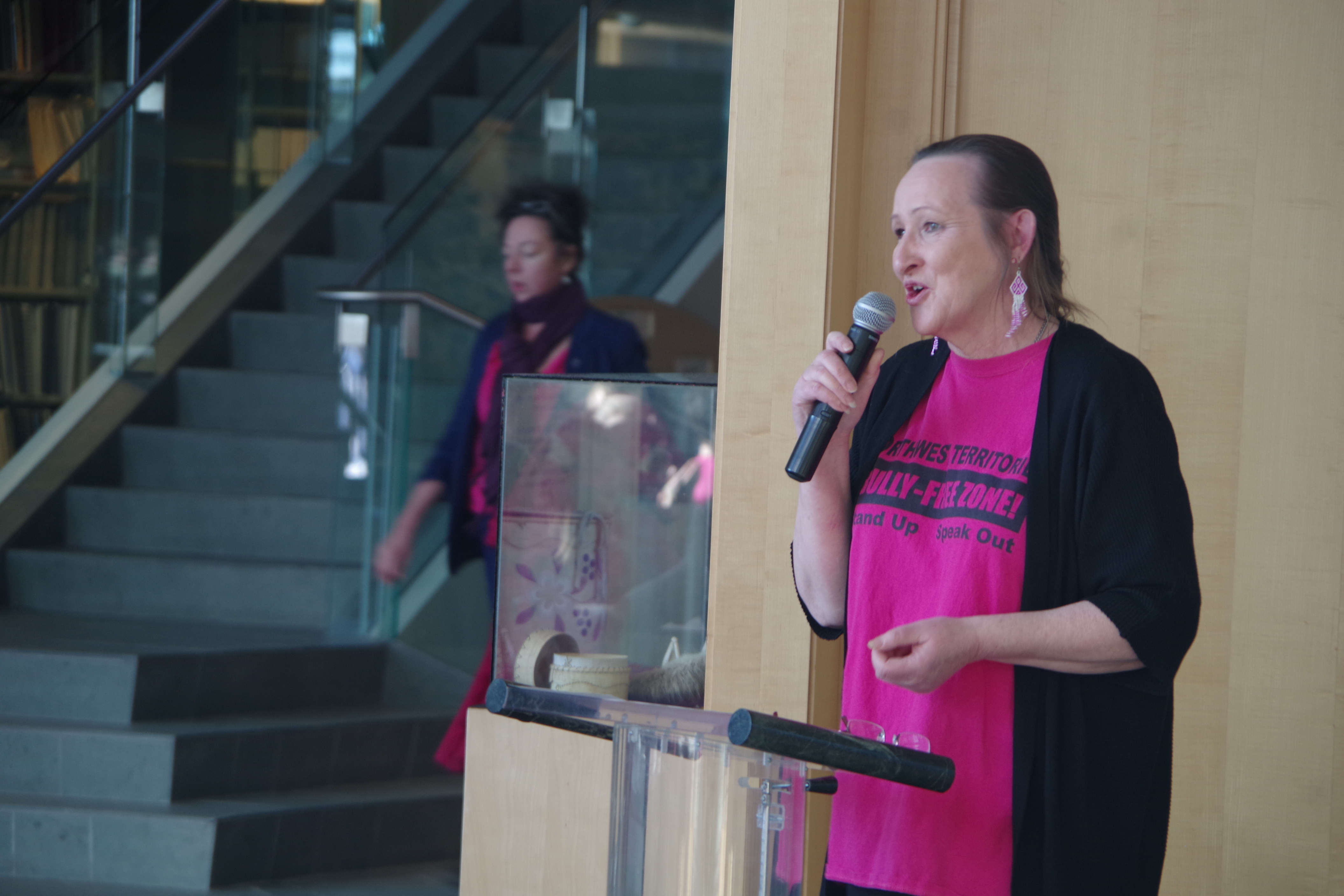
Minister of Education, Culture and Employment Caroline Cochrane spoke to students at a Pink Shirt Day event at the Legislative Assembly February 27th. Emelie Peacock photo

The territorial politician says she felt ashamed for a very long time from third-degree burns on her legs as a result of being in a fire at age seven.

“All of the children laughed at me, they called me a monster, and I hated myself for it,” she says. “I carried that into my teenage years, all the years as I grew up I never wore a short dress because I was ashamed. Ashamed of what my body was because of bullying.”

The Me To We group at William McDonald Middle School shared the actions they are taking on anti-bullying, including a $1,500 grant they received from a video they created, a survey on bullying, and an art project on rising above bullying.

“Everybody comes together wearing pink shirts, and it just really supports anti-bullying,” says Mariah MacIntosh of the meaning behind Pink Shirt Day.

“No one really wants to have a bad day, or to have people talk to them in a really bad way. And if you do raise awareness, people will feel better,” says Kaina Garcon.

These actions are all to combat the issues they see in their school. Solaya Meserah-Zdyb says she sees mostly verbal and cyberbullying at the middle school level, physical bullying comes later in high school.

She says parents should be in the know about the conversations their children are having online. And to check in with them regularly.

“I’d ask ‘how’s the social media going? Are you OK? Are you feeling OK?’,” she says of how parents can approach these types of conversations.


Emelie Peacock
Emelie Peacock
News Reporter

Continue Reading

You may also like


cjcd Now playing play

- Advertisement -

Related Articles

- Advertisement -

Latest News

Tuktoyaktuk RCMP lay charges in bootleg liquor investigation

Tuktoyaktuk RCMP are laying charges following an investigation into liquor bootlegging earlier this week.

Youth engage with Tłı̨chǫ language in unconventional immersive spaces

While in-person On the Land learning continues to be central to Tłı̨chǫ language revitalization, the Tłı̨chǫ language division is looking at ways to engage with youth through new immersive platforms, like virtual spaces, that honour history and traditions. Danielle Dacanay with the Tłı̨chǫ Government’s Language Division emphasized that virtual resources are supplements to learning the language in the traditional way, they are not a replacement for it.

New microgrant stream wants youth to plant language seeds outside school

“100 youth projects wanted in French,” a new microgrant program wants youth to plant language learning seeds outside school. A network of action-research teams in Canada, other parts of North America, Africa and Europe is launching a youth grant stream to support French language engagement outside of conventional spaces. Youth across the country aged 14 to 30 are eligible for 100 microgrants in support of grassroots initiatives as part of this program run by the Dialogue Network.

Water testing at another Yellowknife school confirms elevated lead and copper

Testing at another school site in the city of Yellowknife showed elevated levels of lead and copper in water present in some of its drinking taps. Earlier this month, testing showed four other school buildings in Yellowknife and a school in Behchokǫ̀ had elevated levels of both copper and lead in water. Since comprehensive testing of schools across the territory began this fall, 28 school sites out of 34 announced to date have tested positive for elevated levels of lead.

Testing at more NWT buildings confirms lead in water

Fort Smith officials said water testing at municipal buildings has confirmed the presence of lead. According to the announcement, water samples at the Town Hall, the Fire Hall, and the Municipal Services Building continue to show elevated levels of lead.