



100.1 GO FM - We're Your Feel Good Pop Station

Territory experiences lower than average fire season

 The Northwest Territories experienced a lower than average fire season this year,  the territorial government says.

According to ENR, the wildland fire season in the Northwest Territories begins May 1st and ends September 30th.

On average, there are 224 wildland fires in the NWT every year,  88 per cent of which are caused by lightning.

As of August 22 this year, there were just 54 fires with a total of 11,271 hectares burnt. The 25-year average is 172 fires and 402,976  hectares burnt.
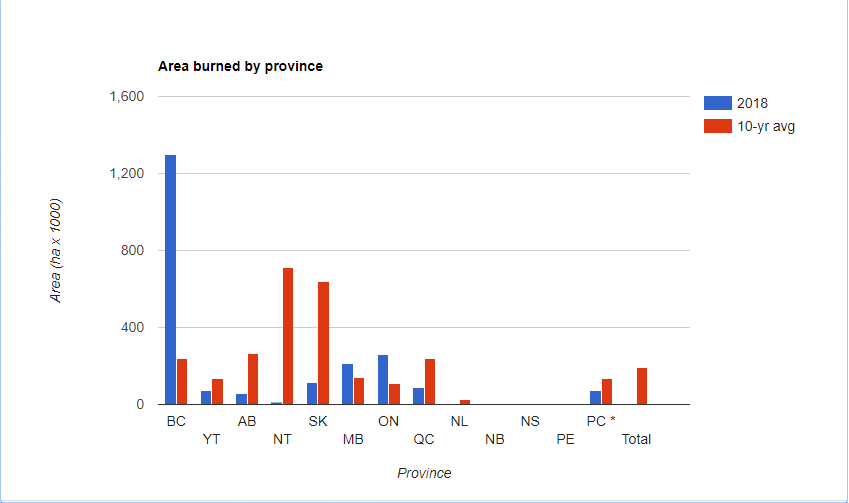
Area burned by fires by province in 2018. From Natural Resources Canada.

It’s regular practice for the GNWT to lend resources to more active jurisdictions when the territory experiences a downturn in fire danger.

As partners in the Canadian Inter-agency Forest Fire Centre (CIFFC), ENR personnel and resources were sent to support wildland fire responses in British Columbia, Alberta, Saskatchewan, Parks Canada, Yukon Territory and Ontario.

Crews that remained in the NWT this season assisted with wildland fire management by performing FireSmart actions and maintenance, such as clearing fire breaks and managing overgrown vegetation, to ensure future protection of communities and other values at risk.

“I am proud of the integrity and hard work shown by our wildland fire personnel this fire season, both at home and while assisting other jurisdictions,” says Robert C. McLeod, Minister of Environment and Natural Resources in a statement.

“Exporting crews not only provides support to our partners in dealing with heavy fire loads, but it also provides valuable experience to northerners who get a chance to work in new environments with crews from across Canada and North America.”

The GNWT sent a total of 76 Type-1 firefighters, 19 overhead staff and 3 air tanker groups to British Columbia and Ontario during this year’s fire season.

Crews and other personnel from all five regions in the territory carried out FireSmart project work, including brush clearing, maintenance on fire breaks and creating temporary helipads.


Meaghan Richens
Meaghan Richens
News reporter. Got news tips? Email me at [email protected] or hit me up on Twitter https://twitter.com/MeaghanRichens?lang=en

Continue Reading

You may also like


cjcd Now playing play

- Advertisement -

Related Articles

- Advertisement -

Latest News

Inuit Nunangat University to begin regional knowledge centre site selection

Following the selection of Arviat, Nunavut, as the site of Inuit Nunangat University’s main campus, the process to choose regional knowledge centres and satellite campuses across Inuit Nunangat is underway. Arviat, with a population of about 3,000, is Nunavut’s third-largest community and has one of the highest proportions of youth in the country.

Premier supports “dual use” aspects of country’s first “Defence Industrial Strategy”

The federal government announced the strategy Monday, describing it as the country’s first national defence industrial strategy. Simpson said those elements are particularly relevant to the North. He said equipment and technology systems intended for use in the Arctic should be tested in the territory’s northern climate and developed in partnership with northern governments, Indigenous rights holders and communities.

Nominee Program opens up for 2026

The Northwest Territories Nominee Program will be opening applications for the employer-driven and francophone streams starting March 9 at 9am.  

Yellowknife Fire Fighter Association campout fundraiser to be held this weekend

The Yellowknife Fire Fighter Association will be holding a campout this weekend on the roof of the Yellowknife CO-OP to raise funds and awareness for Muscular Dystrophy Canada. 

Search continues for ways to deal with 200,000 tons of arsenic dust at Giant Mine

Scientists presented projects for a more permanent solution to hundreds of thousands of tons arsenic dust from the mine. One method uses local beer to fuel a transformation of the toxic dust, while another tries to turn it into glass. Another proposed method looks at turning the dust into a highly sought commodity known as metallic arsenic. Additional proposals look whether robotic technology could allow crews to virtually pilot the extraction of the dust while “sipping coffee” from a distance.


