Students at Kaw Tay Whee Community School in Dettah had camp week this week.
Camp week is an annual event at the school, where students participate in a variety of land-based cultural and language experiences.
It comes on the tail end of two weeks students spent working on their birch tree tap line. Students tap a number of birch trees and harvest the sap in an environmentally conscious way said Lea Lamoureux, the teaching principal of the school.
Lamoureux has been working in education in the Northwest Territories for fourteen years and at Kaw Tay Whee for ten years.
“It’s pretty much the best job ever,” said Lamoureux.
“We have partners at Sapsucker cooperative in Yellowknife, so we put all our sap together and earn back a share. And so it’s really fun, all the students get to bring home a bottle of birch syrup, and so that means they’re on the land over a period of two weeks, harvesting every day,” said Lamoureux.
This year, one of the older classes at the school created a Google Map with GPS coordinates of the trees they were tapping to calculate how much sap was coming out of each tree.
“So they did predictions and estimations, there’s tons and tons of math and a lot of ICT [information communications technology] connected to that,” said Lamoureux.
In the Northwest Territories, public education is founded on a curricular document called the Dene Kede which teaches the ways of the Dene people, which Lamoureux said is used to guide all of their teaching.
“But in the springtime the weather is beautiful and we are fortunate to have some people that we work with at the school who will provide us with a lot of opportunities,” said Lamoureux.
“For example this week we’ve done an otter, we did muskrat, we’re working on a caribou hide, we’re doing ducks, we have a swan, later in the week we’ll do fish and then we’ll probably do a beaver. Woven in with this we’ve also done some drumming, we’ve done some drum making, and we’ve done hand games,” said Lamoureux.
“We were plucking ducks a while ago and now we’re cutting them up,” said Trevor Betsina, who is in grade three.
“We’re gonna eat them for lunch!” another student exclaims.
“People from the community just naturally flow in and out and join us which is lovely. Additionally we work on our Wiiliideh language skills, which is the language where we are,” said Lamoureux.
The school is also piloting the Our Languages curriculum this year, which promotes Indigenous language instruction, both in and out of the classroom.
It is not a graded program, but has five levels ranging from emergent to capable. A students’ proficiency in the language determines the level they work at, rather than their age or grade.
“We’re having lots of natural opportunities to practice the language throughout the flow of the day,” said Lamoureux.
Students spend the majority of the day at the camp doing hands-on activities, and then synthesize their learning through writing in the classroom, said Lamoureux.
“It just builds up better stores of memory and vocabulary and experiences from which the students can draw and share,” said Lamoureux.
“And then there’s tons and tons of links to social studies and science and also physical education, so it’s a very cross-curricular event, and it’s a really nice way to melt a lot of experiences together,” she said.
Some of the students will be recording the experiences with video and photography to create multimedia presentations to preserve the Dene way of knowing and doing things, which will then be shared with the community of Dettah.
“The key thing here, we have really good people we’re working with, of course and the teachers are really open to trying new things and the parents are supportive of it,” said Lamoureux.
Shirley Sangris is a mother and grandmother, and her granddaughter goes to Kaw Tay Whee School. She said she likes that students are learning things the traditional way.
“Even myself too, I’m really interested in learning, because I grew up in the bush, and my mum taught me,” said Sangris.
“She took me to the bush when I was just a year old and I grew up in the bush until I was nine, and then from nine I went to residential school. So I lost my traditional way,” said Sangris.
But Sangris said she finds herself remembering how to do things as she does them, like scraping the fur off of a caribou hide.
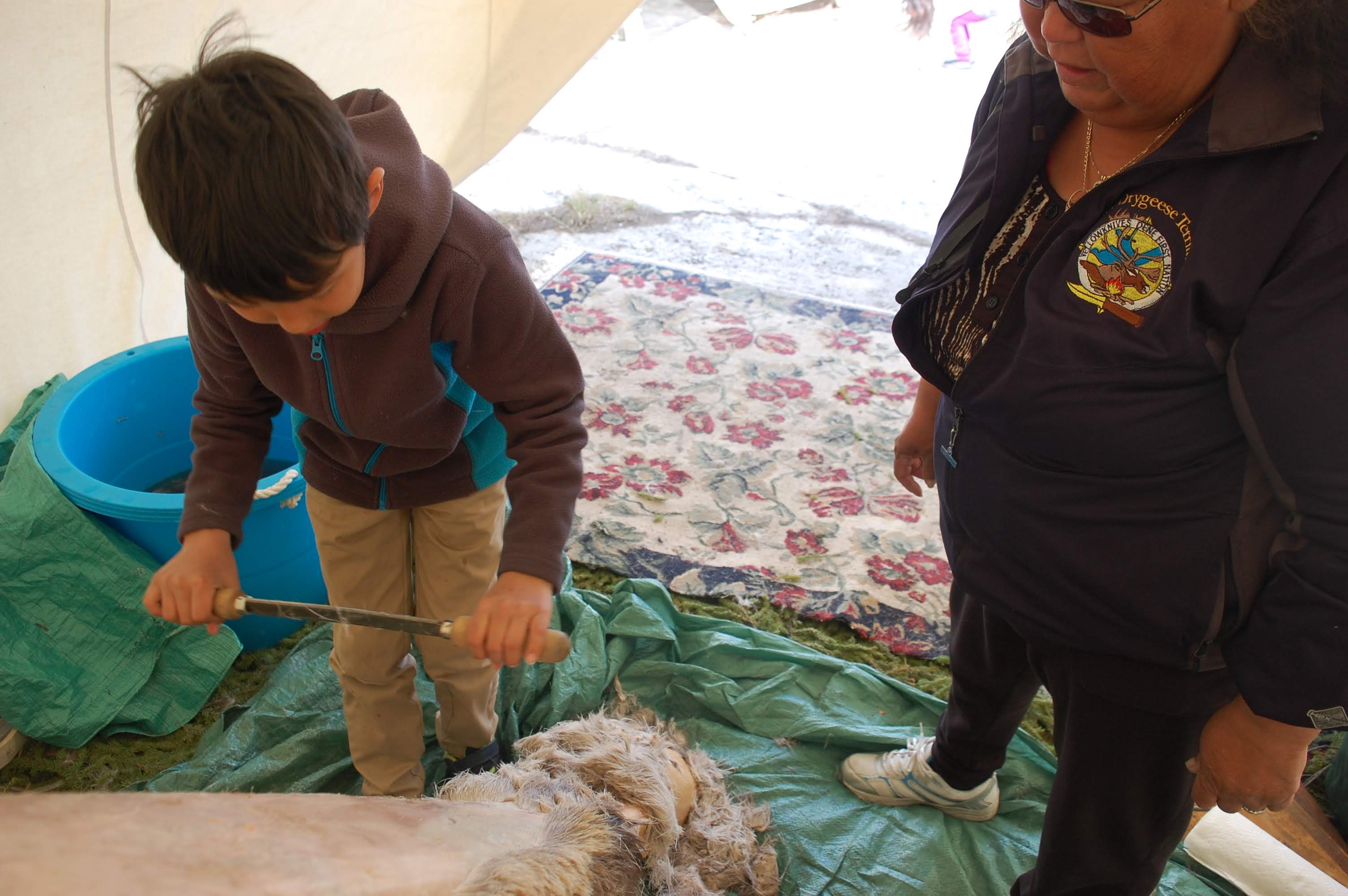
“So I’m learning too,” said Sangris.
Lamoureux said this program is important to her because it’s part of her responsibility as a teacher to promote culturally relevant experiences.
“Almost all of our students are members of the Yellowknives Dene First Nation, so it’s a big important part of my job, and it’s really important too that the experiences are positive,” Lamoureux said.
And all of the people from the community who are working with the kids are part of that, said Lamoureux.
“I think it’s really crucial for the kids to experience the land that they’re on, but also to give them a sense of place and help them be really comfortable in experiencing these activities,” she said.
“I think that when you have teachers that move to new places, it’s important for them to be open to trying new things that may put you outside your comfort zone,” said Lamoureux.
Lamoureux said she feels the school is fortunate to have teachers who are open to learning alongside the students as well as from the people in the community.
“Working at this school has been my dream come true, I really mean that. And so when we get a chance to do things like this all together, it just helps build us as a team, and it helps make stronger connections with people in the community.”
“Working together like that is the foundation of how a strong school is built,” said Lamoureux.
“It’s taken a while, and we’ll keep working at it. It’s definitely a work in progress but we are committed to continuing.”