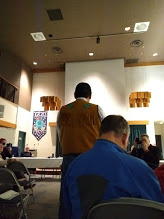

The Giant Mine Oversight Board (GMOB) held a public meeting at Northern United Place in Yellowknife on Tuesday evening.
The GMOB is an independent agency established to oversee the work of the Giant Mine Remediation Project, which is tasked with containing and managing arsenic trioxide waste at the mine site as well as the demolition of buildings on the surface.
Giant Mine is about five kilometres north of Yellowknife, within the city limits and near the communities of Ndilo and Dettah.
The meeting began with a brief overview of the mine’s history and a presentation from GMOB chairperson Kathleen Racher on the board’s 2017 annual report and recommendations.
“As I’m sure most of you already know, there is 237,000 tonnes of arsenic trioxide dust that is underground at Giant [Mine],” said Racher.
“The plan is to freeze it underground to keep it safe and to keep water from getting to it. That will be part of the clean-up process,” Racher said.
The presentation was followed by an hour and a half of questions from members of the public, many of whom voiced their concerns about the health risks of arsenic trioxide.
Among them was Ndilo Chief Ernest Betsina, of the Yellowknives Dene First Nation. Betsina brought up the issue of arsenic hotspots in Ndilo, namely one located near a playground in the community.
“That doesn’t feel very comfortable to me and the safety of the kids that are down there,” said Betsina.
“Will the GMOB come down and identify this area and somehow mark it off and put signage there, so that my people can be informed to keep away from this area? And I want to know how big is this area? How contaminated is it? Will somebody tell me that?” Betsina asked.
“Our mandate is mostly limited to the Giant Mine Remediation Project and the site itself,” Racher responded.
“Having said that, we have noted those hotspots in our report because we’ve heard about it a lot and it’s very important as an indicator of health overall,” said Racher, before passing the microphone to a representative from the federal government to respond.
Natalie Plato, deputy director of the Giant Mine Remediation Project, and was representing the federal government at this meeting.
“I’m sorry that I can’t answer your question… that’s outside my mandate, my scope,” said Plato “I know that the Yellowknives Dene did commission a report, to look at the contamination so there is information available in that report,” Plato said.
“It is on our radar, we are aware of the problem,” said Racher. “Like I say, it’s a bit outside of our mandate, but we don’t want to be the person who just passes the buck, so that’s very challenging,” Racher said.
“Speaking about passing the buck, we’ve talked to federal government and they say well it’s the GNWT’s responsibility” said Betsina. “And then we talk to the GNWT and they say it’s a federal responsibility. So somebody please take responsibility and answer that question to me,” Betsina said.
Betsina invited the board members to hold their next meeting in the community of Ndilo or Dettah.
Another community member asked the board if they could assess the effectiveness of the remediation project and progress made so far.
“How would you rate it?” he asked. “Does it receive a passing grade?”
“There are aspects that are going ahead well, there are aspects of it that we would prefer to see more focused attention and more rapid progress,” said director David Livingstone.
“Certainly not and A, certainly not and F, but it’s a complicated project and a complicated environment,” Livingstone said.
The subject of a formal federal apology and compensation for the Yellowknives Dene First Nation arose more than once, as well as the larger issue of reconciliation.
“We [GMOB] have for two years running recommended that the federal government engage with the Yellowknives and other Indigenous people about compensation and an apology, a sincere apology, for what has happened,” said Livingstone.
“We wrote to the prime minister this year and got a fairly tourist response saying that he’s directed his responsible ministers to follow up… We take that word and that responsibility very seriously and will continue to work toward meaningful reconciliation with affected Indigenous peoples,” said Livingstone, adding that he looks forward to having the next meeting in Ndilo or Dettah.
The remediation project team anticipates having the proper permits to begin cleaning up the mine site by 2020, and the clean-up itself is expected to be complete by 2026.