Leaders of the Giant Mine clean-up say technology that freezes toxic material underground has now been tested at the site and proven successful.
At a public forum on Thursday, managers of the federal government project discussed progress at the site, just north of the city of Yellowknife.
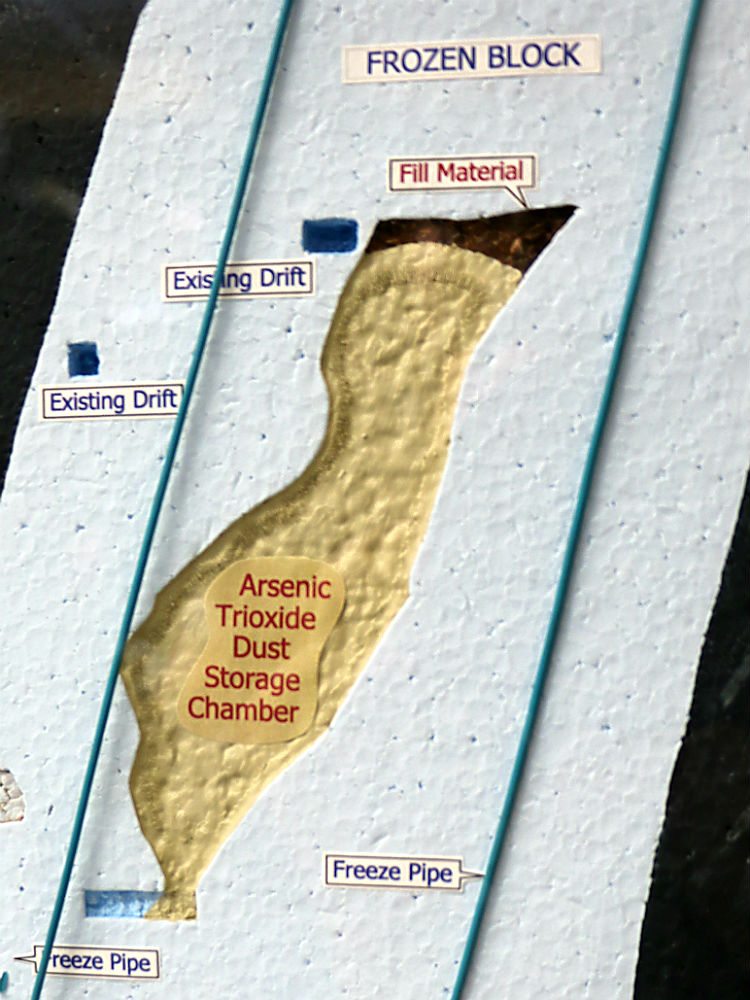
More than 200,000 tons of toxic arsenic trioxide lies in chambers beneath the former gold mine. The project calls for those chambers to be frozen.
The theory is that by keeping the chambers permanently encased in ice, none of the toxic waste – nor any water – can get in or out, keeping the waste safely locked away.
The Giant Mine team recently finished reviewing data from a “freeze optimization study”, which used one of the chambers as a test to determine the best way to freeze the chambers.
Team experts say the final results are promising.
Read: Giant Mine’s freeze optimization study explained
“We were very successful in freezing that chamber. The technology works,” engineering manager Jane Amphlett told Moose FM.
“I’m very confident this is the solution. This is what’s going to stabilize this material; make sure that material stays there, that it doesn’t get out, that it doesn’t impact the community.
“This is what’s going to work for Giant Mine. This will get us where we need to be.”
Work to freeze the remaining chambers is still at least four or five years away. Plans are still being finalized and approved, as are costs. The final bill for remediation of the site – already close to a billion dollars – may creep upward.
In the meantime, workers must take steps to make sure the mine site is safe and minimize the risk of waste escaping.
In the past year, that has meant carefully dismantling and storing the highly contaminated roaster complex, where ore was once roasted to release gold.
Now, the C-shaft headframe is set to be taken down as it has become structurally unstable and poses a risk to workers.
Read: Giant Mine’s C-shaft at risk
Work is also taking place to fill in an underground chamber and prop up a pit wall, to ensure Baker Creek – which runs across the mine site – does not infiltrate any contaminated areas.
Amphlett admits it is a ‘challenge’ to convince everyone that freezing the chambers is the best approach.
Some critics are concerned about the open-ended nature of that solution. The federal government’s commitment is to keep the chambers frozen for at least a century, with a review every 20 years to see if new scientific solutions are available.
Yellowknife Centre MLA Robert Hawkins has long proposed offering a $10 million prize to help find a different, better solution.
In the legislature earlier this month, Hawkins said an eight-figure prize would “help us solve this problem by putting the information out there and inviting the world to come capture a reward”.
The territory’s environment minister, Michael Miltenberger, said offering a prize “has not been seriously looked at”.
Read: Robert Hawkins’ question at the legislature on OpenNWT
Amphlett questions whether offering a prize is the most appropriate method.
“From our perspective, we put a lot of work into the freeze,” she said.
“We investigated a lot of options in coming up with the freeze. We started with 56 options and we vetted it with experts all over the world.
“The environmental assessment confirmed the freeze is good and it’s going to work – it’s what we’re proceeding with – but it did recommend for us to do research to keep looking for other potential solutions. We’ll be funding research and if there’s a better solution in the future for Giant, that’s the best way to make sure that’s being investigated.
“The venues that are more appropriate for inspiring people to find a solution are existing venues – through research, through various universities or companies that may be interested in finding a solution.”
Amphlett does, however, understand why people are sometimes reluctant to embrace the concept of the freeze.
“It is a challenge, because it’s a complex project. People do struggle to understand exactly what we’re trying to achieve out there,” she said. “That’s why we try to do lots of public forums, ways for people to get information, learning what we’re doing out there and why.
“In some ways the concept is quite simple in terms of freezing rock, but people do have concerns about how it will work and how robust it will be.
“Once it’s frozen, it will be frozen. It’s very robust, it will last for the long-term.”