100.1 GO FM - We're Your Feel Good Pop Station

Snowking to unveil supersized 20th anniversary castle

Yellowknife’s Snowking is preparing to unveil his 20th anniversary castle on the frozen Great Slave Lake.

The grand opening takes place at noon this Sunday, March 1.

“Because it’s our 20th, we want to stuff a lot of stuff in that castle, so we had to have the space,” Snowking told Moose FM.

“People are going to find it’s a really huge castle this year. We’ve taken our ice masonry to an even bigger level.”

The month-long Snowking Winter Festival features art shows, a film festival, musicians, and a Royal Ball on Saturday, March 7.

For a second successive year, Snowking said cold temperatures had delayed construction – and there is now a rush to complete several remaining walls before Sunday’s opening.

“The cold weather was really tough for us and hard on the tractor,” he said.

“I broke it a couple of times. Luckily our good friends at Ron’s Auto were able to fix it right away.

“Back in the old days we used to just use a snowblower and build with bricks – that gave us a 22-inch wall. But in late March, the outside of the castle would start to deteriorate. We once lost a portion of wall and had to shut her down sooner.

“We’ve switched over now to pouring three-foot walls, so we’ve really upped the game.”

More details: Snowking Winter Festival official website

Sunday’s opening ceremony will include a contest to guess where the castle’s entrance is located.Snowking
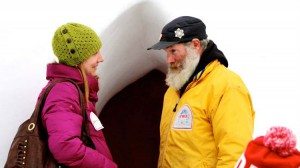
The front door has been built but is currently hidden from view.

“We have our door installed in the snow but we haven’t revealed it on the outside,” said Snowking (pictured, right).

“You’ve got to figure out where you think the doorway is going to be and stand there. If you’re lucky enough to see a saw poking through the wall at noon on Sunday, that’s where the door is being cut.”

He added the first few people into the castle will “be let in with a treat”.

Ollie Williams
Ollie Williams
Hello! I'm the one with the British accent. Thanks for supporting CJCD. To contact me, you can email me, find me on Twitter or call (867) 920-4663.

Continue Reading

You may also like


cjcd Now playing play

- Advertisement -

Related Articles

- Advertisement -

Latest News

Inuit Nunangat University to begin regional knowledge centre site selection

Following the selection of Arviat, Nunavut, as the site of Inuit Nunangat University’s main campus, the process to choose regional knowledge centres and satellite campuses across Inuit Nunangat is underway. Arviat, with a population of about 3,000, is Nunavut’s third-largest community and has one of the highest proportions of youth in the country.

Premier supports “dual use” aspects of country’s first “Defence Industrial Strategy”

The federal government announced the strategy Monday, describing it as the country’s first national defence industrial strategy. Simpson said those elements are particularly relevant to the North. He said equipment and technology systems intended for use in the Arctic should be tested in the territory’s northern climate and developed in partnership with northern governments, Indigenous rights holders and communities.

Nominee Program opens up for 2026

The Northwest Territories Nominee Program will be opening applications for the employer-driven and francophone streams starting March 9 at 9am.  

Yellowknife Fire Fighter Association campout fundraiser to be held this weekend

The Yellowknife Fire Fighter Association will be holding a campout this weekend on the roof of the Yellowknife CO-OP to raise funds and awareness for Muscular Dystrophy Canada. 

Search continues for ways to deal with 200,000 tons of arsenic dust at Giant Mine

Scientists presented projects for a more permanent solution to hundreds of thousands of tons arsenic dust from the mine. One method uses local beer to fuel a transformation of the toxic dust, while another tries to turn it into glass. Another proposed method looks at turning the dust into a highly sought commodity known as metallic arsenic. Additional proposals look whether robotic technology could allow crews to virtually pilot the extraction of the dust while “sipping coffee” from a distance.