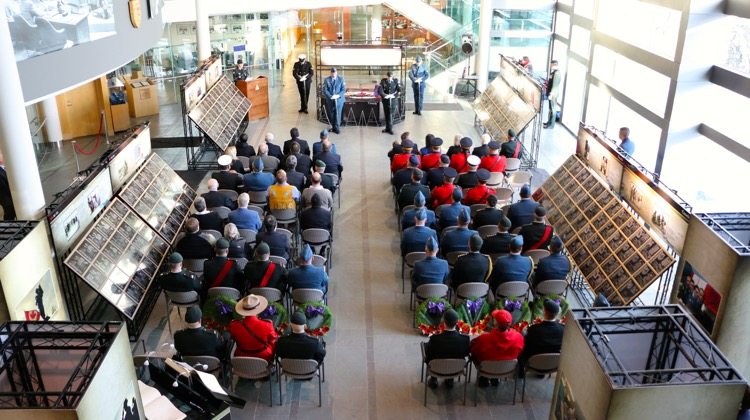
When Major Darren Persaud stood in front of plaques at the Afghanistan Memorial Vigil in Yellowknife, he saw more than faces.
Sadly, the military chaplain – after three tours of Afghanistan – knew many of those commemorated by the plaques only too well.
Here, as told to Moose FM on the day of the vigil’s opening ceremony, is how Major Persaud reflects on what the vigil meant to him.
I’ve served for 12 years. I was in Afghanistan in 2004, 2008 and 2011, with the Air Force, Army and special forces.
When I look at a lot of the faces on the plaques at the vigil, I either was with them, or part of the chaplain team that would notify their families when they passed away overseas.
It’s really hard to even begin to talk about it.
Photos: Afghanistan Memorial Vigil in Yellowknife
I think, over time, I got better at coping with talking to the families. Not that it’s ever easy, but you really have to understand how to take care of yourself by creating a great support network, which I’m very thankful to have – be it other chaplains, social workers, the medical professional or other soldiers themselves. It’s so important for us.
Things like the vigil’s opening ceremony are a reminder of that great support network we have, and give us a chance to grieve and honour at the same time, so you don’t keep the feelings all inside.
That’s what I learned in the first tour – I kept a little bit too much in, rather than being able to express appropriately how to deal with grief, anger, all the different things that can happen in that stressful environment.

There’s really no more stressful environment that I’ve experienced, after living in Canada all my life, always feeling safe and secure, then realizing how much you take that for granted once you go somewhere where peace is a dream. Something you wish, hope, and fight for.
To see these faces, it brings it all back to life.
I’ve been based in Yellowknife for two years, now. It’s been a very large blessing for me.
In some aspects, the North reminds me of the desert: the isolation, sometimes the poverty, how harsh the climate can be, how fierce the landscape is.
It’s been an honour to serve here, especially with Joint Task Force (North) and the Rangers. It’s been a real blessing to start to have an impact at home – a lot of my operations have been overseas, so this has been a chance to focus on doing good work here at home, with some wonderful communities all over the North that face a lot of adversity.
I visit communities with the Canadian Ranger patrol group. They take a chaplain along at various times, especially if a community has gone through a lot of grief.
I just came pack from a patrol in Cape Dorset. I got to visit them and experience minus-60 with the Rangers on the land.
They really teach you a lot, it was very eye-opening.
I’m a bit of a big-city kid. I’m not used to those type of circumstances, using a tent and a little Coleman stove to keep yourself warm.
It’s always very entertaining and, thankfully, they’re very patient with me and my poor snowmobiling skills.