



100.1 GO FM - We're Your Feel Good Pop Station

Hay River’s fishing industry gets $1.4M boost from GNWT

Hay River’s fishing industry isn’t what it used to be, but a new revitalization project is hoping to bring it back to its glory days.

NEW: Indigenous interests ‘neglected’ in new GNWT fisheries project

RELATED: Hay River fishing: two fined for illegal harvesting

The GNWT committed $1.4 million as part of a five-year plan to revitalize the territory’s commercial fishing sector in Hay River Monday morning.

The Strategy for Revitalizing the Great Slave Lake Commercial Fishery aims to increase production and fish processing in the community, along with increase domestic and export market sales by 2021.
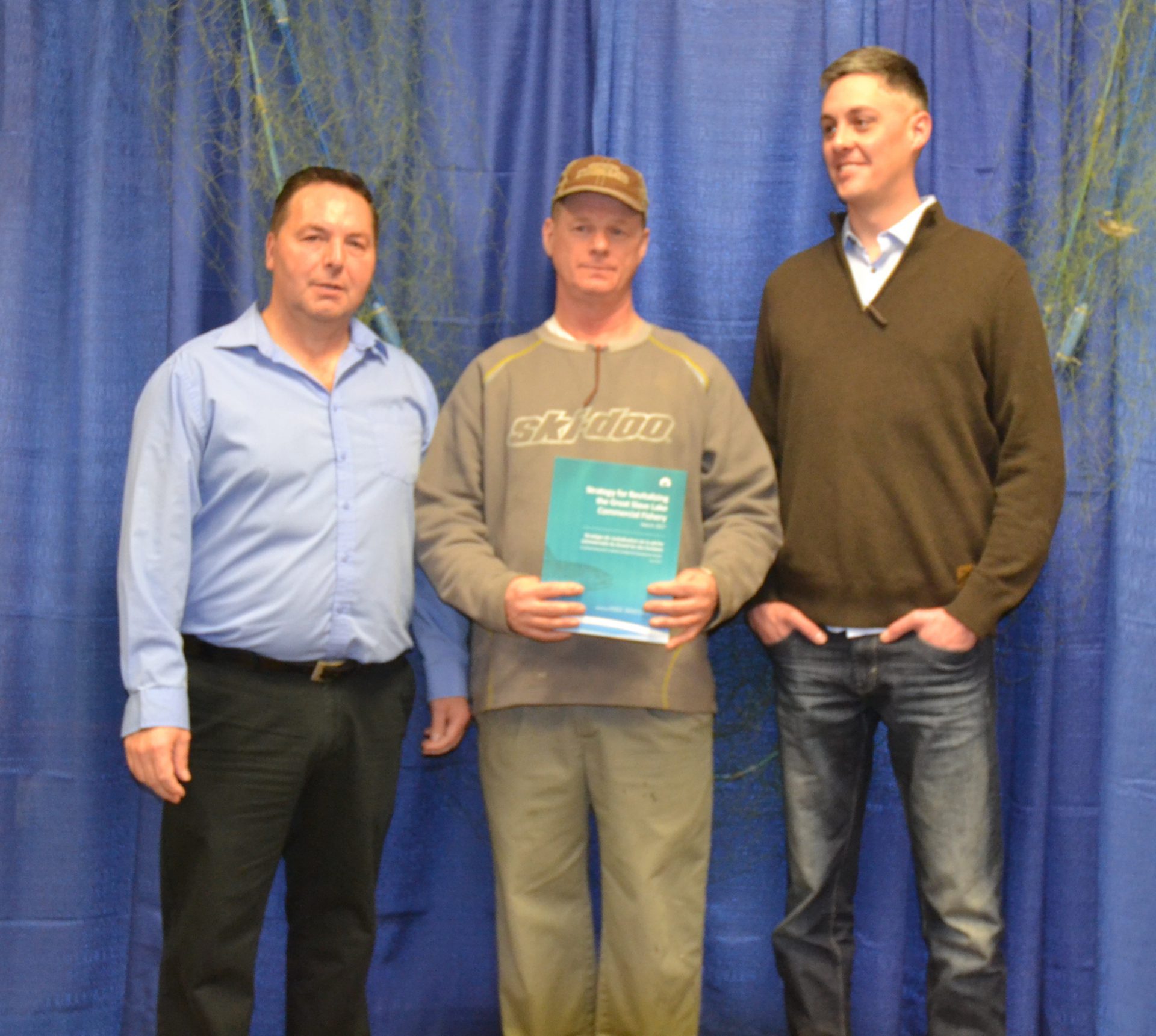
Minister Wally Schumann, left, during the revitalization strategy launch in Hay River Monday. (Photo provided by Myrtle Graham).

“[The revitalization] means a lot to Hay River,” said Industry, Tourism and Investment Minister Wally Schumann.

“Hay River has been the core area of the commercial fishing industry since the 1940’s. It’s a big part of our community, it’s probably one of the main reasons how the community came into existence, and it’s declined.

“I’ve been living in Hay River for 32 years and I’ve seen the number of participants drop off, and that quota’s dropping off, and this was something that needed to be done to bring us back to life.”

Commercial fishing began on Great Slave Lake in 1947.

At its height, Hay River was producing 1.3 million kilograms of fish a year. Last year it produced around 400,000 kilograms, something Schumann called ‘a very good year’.

“The production numbers have dropped off over the years,” Schumann said.

“The way of doing business has changed, the fishermen needed some assistance. It’s not the same as when they were fishing in the 1970’s and 1960’s.”

With the revitalization, the project hopes to keep jobs and training in Hay River.

Many of the community’s fishermen are older gentlemen, Schumann says, and the GNWT is looking at ways to get younger people into the sector.

If successful, the strategy believes it will lead to an annual benefit of over $6 million to the NWT economy coming out of Hay River alone.

The project has seven focus areas to move the industry forward, including looking at how to add value to the NWT economy, restarting the winter fishery and encouraging new entrants to the Great Slave Lake fishery.

The GNWT is currently looking at what it needs to do to help the industry, be it through investing in a new fish plant, creating different types of zones on lakes or gaining access to export markets.

“There’s a huge opportunity and we’re not utilizing the fish that’s in the lake,” said Schumann. “We need to figure that out, and that’s what this plan’s about.”

NEW: Indigenous interests ‘neglected’ in new GNWT fisheries project

Continue Reading

You may also like


cjcd Now playing play

- Advertisement -

Related Articles

- Advertisement -

Latest News

Series of “mock testing” using virtual tech to take place at Inuvik hospital

“We're expanding to have audio scopes and stethoscopes and we're looking at other tools that can be used. So that the virtual care out of Stanton or Inuvik can be provided into our smallest of communities. So a physician has always been available in those locations, via phone or travelling to them. But now we're offering a broader base. Connectivity has been resolved in part by using what's there, investing in new technology - so satellite connectivity,” said Dan Florizone

North braces for public service impact, where ‘small’ cuts run “deep”

"The impact on Northern and remote and Indigenous communities where we already know sometimes there is one position in the community, there is only a skeleton crew providing services can be felt definitely by Northerners who depend on certain services that are crucial to them," warns Josée-Anne Spirito, regional vice president at the Public Service Alliance of Canada.

Imperial Oil to end Norman Wells operations by summer 2026

Imperial Oil Ltd. will end production at its Norman Wells facility in the Northwest Territories in summer 2026.

Will LWBs guidelines bring awareness about water laws and compensation?

Gwich’in, Mackenzie Valley, Sahtu, and Wek’èezhìı Land and Water Boards – collectively, the LWBs have released a set of guidelines to raise awareness about the existence of water laws and the claims compensation process in the N.W.T. Despite the N.W.T. 's long history of mining, there have been few applications and leaders at the organization say a lack of awareness of the laws and lack of accessibility to the legal language of the water acts is part of the reason why.

Mackenzie Valley Hwy updates coming soon

“The sessions will provide an update on the Mackenzie Valley Highway Project, including an update on the environmental assessment process and timelines for regulatory milestones. Updates will also include planned engagement on multiple topics beginning in 2026 and ongoing through construction of the Project. Topics will include development of the Community Readiness Strategy, Corridor Working Group and Sub-Working Groups, and management plans for the Project,” said Lapointe.



