
New research indicates that wood bison in southern regions of the NWT are being displaced because of the effects of climate change.
Researchers from the University of Ottawa, five partner universities and the territorial government argue that climate change is causing extensive lake expansion and landscape flooding in the area.
RELATED: Wood bison listed as threatened species in Northwest Territories
That’s affecting the core habitat of a wood bison population that is already vulnerable and listed as threatened under the NWT Species at Risk Act.
“The Mackenzie Bison Sanctuary, on the north shore of Great Slave Lake, is home to an important population of wood bison,” said Jennifer Korosi, co-lead author of the paper, published in the journal Nature on Thursday.
“Observations over the last decade by local land users and wildlife managers suggest that the lakes of the region have expanded, flooding large areas of sedge meadows.”
As part of the study, researchers analyzed satellite images taken between 1986 and 2011.
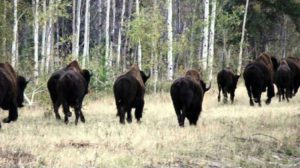
Their findings show that lake surface areas nearly doubled over that period – a phenomenon that has had a significant impact on bison herds in the area.
“As the lakes have expanded, the Mackenzie herd appears to have abandoned the former core of its range within the protected area of the sanctuary in search of forage,” said co-author Michael Pisaric, a professor at Brock University.
Pisaric argues that those habitat changes have forced herds elsewhere, increasing the risk of bison-vehicle collisions along Highway 3.
In addition to analyzing satellite images, researchers also looked at soil and sediment samples in the area.
Their research confirmed that flooding of the landscape over the past two decades is unprecedented in over 200 years – a clear indication that climate change is to blame.
“Our findings clearly indicate that increases in lake size, as a result of climate change, have directly impacted the use of the land by threatened wood bison,” added Jules Blais, co-author and professor at the University of Ottawa.
Less than a year ago, wildlife officials estimated there were fewer than 2,500 wood bison remaining in the Northwest Territories.
It’s believed that the territory is home to 32 per cent of the world’s wood bison population. As the largest land mammal in North America, they are important grazers and a key component of the boreal forest ecosystem.
But remaining herds are facing a number of legitimate threats, including disease, increased predation and human-caused death.