
GNWT announces $20M for access road near Norman Wells

The Government of the Northwest Territories and the federal government will be investing $20 million for the construction of a 14-kilometer all-season access road connecting Norman Wells to Canyon Creek.

The announcement came Thursday, and includes the construction of the all-seasons road, along with an additional five kilometers of roads around Canyon Creek.

The improved infrastructure means essential goods and equipment will be transported more easily throughout the area, and will “improve access to traditional Sahtu lands for recreation, tourism, and business development,” according to a GNWT press release.
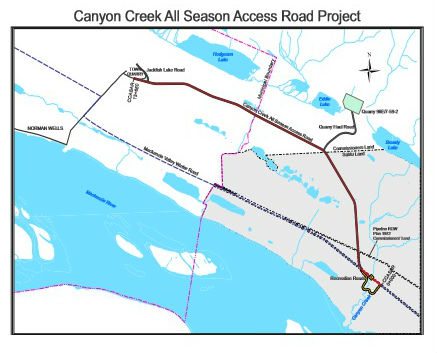
Canyon Creek all weather road

The all-season road will replace the segment of the Mackenzie Valley Highway that’s constructed annually between the two communities.

The territorial government is providing $5 million in funding towards the $20 million project, with the remaining $15 million coming from the federal government through the Small Communities Fund.

“It’s a great investment,” said Wally Schumann, the territory’s transportation minister.

“$20 million going into the region where oil and gas has essentially come to a dead-stop, it means there’s some investment there and this is a great opportunity for a region that’s remote and a significant contribution to the economy in the next few years.”

The GNWT says other local communities are also expected to benefit from Thursday’s announcement.

“Residents, businesses and contractors in Tulita and Norman Wells will particularly benefit from the related business and employment opportunities [that come with the road],” read a press release.

“In addition, through training, this project will increase the capacity of local people and businesses to service future construction projects.”

The GNWT says the project will offer training opportunities to around 12 trainees and 16 heavy equipment operators, and provide work for up to 50 people during the construction phase.

Most of that staff is expected to be hired locally.

Continue Reading

You may also like


cjcd Now playing play

- Advertisement -

Related Articles

- Advertisement -

Latest News

Yellowknife councillors consider request to endorse a new federal election format

At a presentation to city council on Wednesday, Jeremy Flatt requested that the city endorse a resolution calling for a proportional representation model for federal elections. If city coucnillors decide to support the request, Yellowknife could become the first city in Canada to endorse the alternative federal voting system. Flatt said that some have called it a “more democratic” system.

Diavik mine near Yellowknife officially ends operations in celebration

After more than two decades of operations the Diavik diamond mine announced that it has officially closed production. The mine in operation for over 20 years northeast of the city of Yellowknife processed its last truck of ore on Tuesday.

Yellowknife’s Leah McShane shines bright as Loran 2026 Scholar

Leah McShane, a Yellowknife high school student, was just named a Loran Scholar for 2026, out of more than 5,400 applicants across the country. The student from École Sir John Franklin High School made it through four selection rounds to receive the award. “With a little bit of work you can do anything you set your mind to,” said McShane, who hopes she can inspire more youth to follow their dreams.

Indigenous languages pilot program to launch at NWT Legislative Assembly

A new pilot program will connect fluent Indigenous languages speakers to interpreter roles at the N.W.T Legislative  Assembly. The pilot program will run from May 2026 to March 2027, with one applicant selected for each of the N.W.T.’s official Indigenous languages: Dene Kǝdǝ́ (North Slavey), Dëne Sųłıné (Chipewyan), Dene Zhatıé (South Slavey), Dinjii Zhuʼ Ginjik (Gwich’in), Inuinnaqtun, Inuktitut, Inuvialuktun andTłı̨chǫ.

GNWT reminds residents not to dump trash on public land

The Government of the Northwest Territories is reminding residents that dumping garbage, appliances, or construction materials on public land is harmful to the environment and to wildlife and is illegal under territorial legislation.