Northerners are becoming more reliant on food banks to get their next meal, according to this year’s Hunger Count report (pdf).
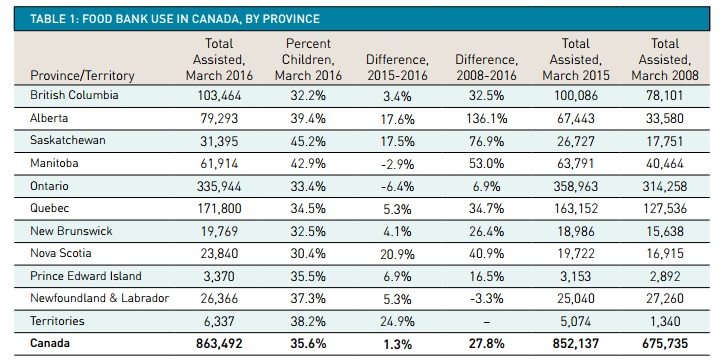
Food Banks Canada says 863,492 people received food from a food bank in the country this past March. That’s 1.3 per cent higher than it was in March 2015 and 28 per cent higher than in 2008.
The organization says food bank use is on the rise across the country, but a number of jurisdictions – including the territories – have seen ‘drastic’ surges in use.
“This year’s increase in food bank use was widespread, with eight out of ten provinces experiencing a hike and Alberta, Saskatchewan, and Nova Scotia showing drastic surges of more than 17 per cent,” the report stated.
“The unacceptably high need for food banks … is driven by short-term economic disruption and the long-term failure of governments to provide adequate supports to Canadians who have fallen on hard times.
“The report paints a distressing picture across broad regions of the country.”
In terms of jurisdiction, Canada’s three territories saw the biggest spike in food bank use from 2015 to 2016, with an increase of 24.9 per cent (5,074 people were assisted in 2015 versus 6,337 a year later).
In March 2008, only 1,340 people relied on food banks across Canada’s territories – roughly one fifth of this year’s total.
Of the 863,492 people that visited food banks across Canada this past March, 36 per cent were under the age of 18.
Meanwhile, First Nations, Métis, and Inuit people accounted for 14 per cent of people who received food nationally.
How to combat food insecurity in the North
In its list of recommendations, the report says few social issues have received as much attention in the past year as food insecurity in Northern Canada.
To combat the issue, Food Banks Canada recommends creating a national basic income that is connected to the true cost of living in different parts of the country.
Basic income is a social policy that would supplant various welfare programs by providing a baseline amount of money to all citizens, regardless of whether they work or meet a means test.
Food Banks Canada also suggests strengthening the Nutrition North food subsidy program, expanding access to country foods and supporting the transportation of food by sealift and not just by air.
The report stated: “Food will not become broadly affordable … unless we combine our attention to the cost of food with action on social assistance, access to traditional foods, and the infrastructure deficit in Northern Canada.”