


100.1 GO FM - We're Your Feel Good Pop Station

Seeking reconciliation through The Stories from the Land

Anishinaabe comedian and activist Ryan McMahon stopped in Yellowknife Monday as part of his project to collect stories from Indigenous communities across the country.

It’s all part of his podcast project The Stories from the Land, which is aimed at reconnecting his people with their lands.
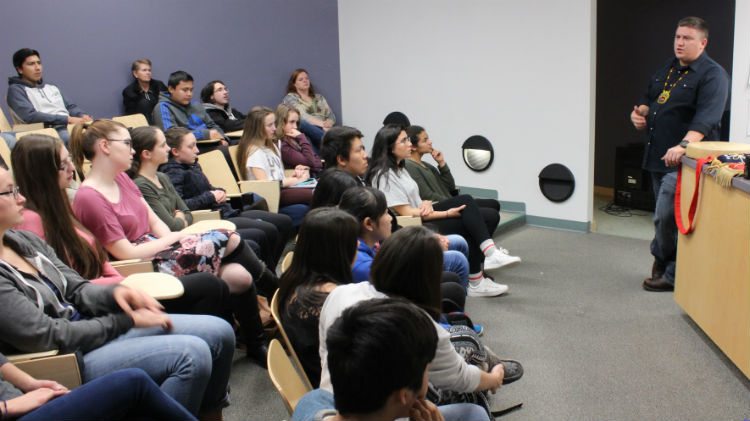
Ryan McMahon presents a workshop to students at Sir John Franklin high school.
Ryan McMahon presents a workshop to students in Yellowknife.

On Monday afternoon, he gave workshops at Aurora College and Sir John Franklin High School, speaking to students about his experiences as an Indigenous person.

He shared stories about his suffering abuse as a child, his parent’s struggles with addiction, and how he was the first Indigenous person to audition for Saturday Night Live.

In the end, he says, Stories from the Land is meant to start conversations about Indigenous people’s lives in Canada and to spark reconciliation by reconnecting them with their land and culture.

“For 150 years, the whole project in Canada has been about removing Indigenous people from land,” McMahon said.

“I want to have that conversation about reconnecting our communities to the places they’re from and not apologizing for it and not saying sorry for being Indigenous.”

McMahon believes that through mediums like his podcast, Indigenous people can share their stories and pass on updated traditions about their people in a modern context.

“We’re only 150 years old, it’s not too late to make things right, it’s not too late to have these conversations,” he said.

“If we’re talking about reconciliation we should be brave enough to talk about all of the issues.”

McMahon says issues like poverty and violence exist within Indigenous communities because they were taken from their original land.

“Land is central to life, it’s central to our way of life, it’s central to our food sources, it’s central to everything,” he said.

“If we don’t look at the fact that Canada controls 99.8 per cent of all land in this country, if we refuse to acknowledge that then we’re just going to continue to perpetuate these cycles of poverty and violence.”

The storytelling workshops are meant to empower people, whether Indigenous or not, and are intended to create a healthy path forward towards reconciliation in Canada.

In total, McMahon plans to collect 60 original audio stories on his country-wide tour.
 

Continue Reading

You may also like


cjcd Now playing play

- Advertisement -

Related Articles

- Advertisement -

Latest News

Relentless Indigenous Woman talks languages, “literally” changing world

Dr. Candace Manitopyes, aka The Relentless Indigenous Woman, is working with Elders and Language Keepers in the North and across Turtle Island on relaunching an Indigenous languages program. Dr. Manitopyes says there is an urgency to support Indigenous language learning, especially for Northern First Nations communities, where culturally responsive community rooted resources are even more scarce.

New generation of Indigenous languages speakers celebrated in the NWT

“The language is who we are. Language is our Elders. Language is what makes us who we are,” said Paul Andrew, who emceed a special gathering in Yellowknife that included mentors and apprentice Indigenous language learners, their families, organizers and community leaders. This year’s cohort engaged in learned the languages of Gwich’in, Tłı̨chǫ, Inuvialuktun, Inuinnaqtun, Inuktitut,Dene Kede, Dene Zhatıé, Nêhiyawêwin, Dëne Sųłıné and Wı̀ılı̀ıdeh. 

NWT services to be made accessible in Indigenous languages, says GNWT

The territorial government will soon begin offering all services in each of the 11 official languages including the nine Indigenous languages of Dinjii Zhu Ginjik (Gwich’in), ᐃᓄᒃᑎᑐᑦ (Inuktitut), Inuvialuktun, Inuinnaqtun, Dene Kǝdǝ́/ Sahtúot'ı̨nę Yatı̨ (North Slavey), Dene Zhatıé (South Slavey), Tłı̨chǫ, Dëne Sųłıné (Chipewyan) and Nëhiyawëwin (Cree). Previously, the services had been available in English and French only.

Support and funding for “Language Cafes” to launch this spring

The NWT Literacy Council has started a new funding program to help support Indigenous language revitalization. Kathryn Barry Paddock, Executive Director of the NWT Literacy Council made the announcement that the organization is promoting more funding and the creation of more accessible spaces for Indigenous language through "Language Cafe" events.

City of Yellowknife signs cross territorial MOU with Whitehorse and Iqaluit

The city of Yellowknife, Whitehorse and Iqaluit signed a Memorandum of Understanding yesterday at a summit in Whitehorse. The agreement is aimed at building collaboration between the three communities as among the major hubs and capital cities of the North.




