



Yellowknife transitional home building seven new apartments

The Salvation Army is planning an expansion of its Bailey House, Yellowknife’s transitional home for men trying to get off the streets, by seven apartment units over the next few months.

For six months now, the transitional home on Franklin Avenue has been at full occupancy of its 32 rooms, causing a real problem for any new potential occupants trying to find a place to stay.

“It is plum full of people, and we need to look at other avenues to be able to increase housing supports,” said Dusty Sauder, executive director of the Salvation Army in Yellowknife.

He says that between Bailey House and the emergency shelter, those two havens for homeless men in the community have been running almost full ‘all the time.’

“The shelter is constantly pushing near its designed limit (of 49 occupants) … and Bailey House is full so obviously the need is there,” said Sauder.

“And if the need’s there then we need to look at expanding the services.”

RELATED: ‘I am concerned’: Yellowknife homeless shelter nears capacity
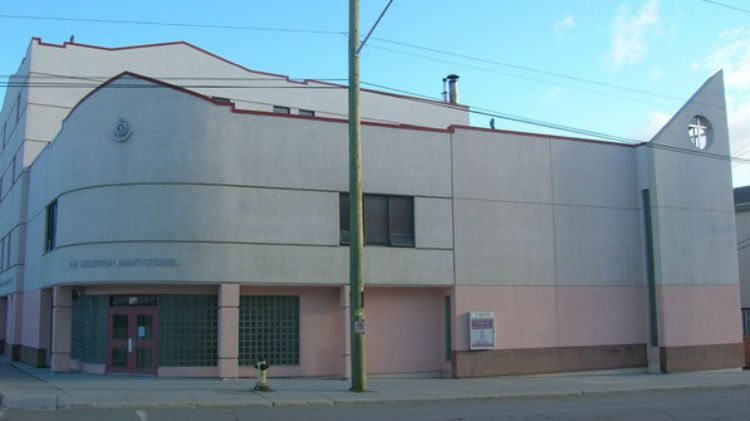
The Salvation Army in Yellowknife.

The plan is still awaiting approval from Salvation Army headquarters in Toronto – where it is going through a program review – along with assessing the financial feasibility of the Yellowknife chapter’s ability to operate and maintain the added facilities.

There are two different sizes of units within Bailey House – one described as more of a hotel-room style with a full bathroom and a spot for a bed and some dressers with shared kitchens.

The other is more of bachelor suite with a full kitchen of its own with everything else included within the unit.

The proposed new units would have one shared kitchen and one shared common area while the seven apartments would contain just a closet and bed, according to Sauder.

“We need to try to keep costs down to be able to have it feasible,” he explained.

The NWT Housing Corporation will be providing $300,000 in funding to the project. According to Sauder, they hope to have it finished by February 2017 once it’s approved.


Continue Reading

You may also like


cjcd Now playing play

- Advertisement -

Related Articles

- Advertisement -

Latest News

GNWT, Indigenous govts and feds to help workers impacted by Diavik closure

“As this mine closes, our message to workers is simple: you are not on your own,” says Minister Caitlin Cleveland. On Tuesday, the Diavik Diamond Mine processed its last truck of ore. More than 1,100 workers from the N.W.T. were employed at the mine in operation for over 20 years. About 200 workers will continue their roles on site as part of active closure in 2026.

Yellowknife councillors consider request to endorse a new federal election format

At a presentation to city council on Wednesday, Jeremy Flatt requested that the city endorse a resolution calling for a proportional representation model for federal elections. If city coucnillors decide to support the request, Yellowknife could become the first city in Canada to endorse the alternative federal voting system. Flatt said that some have called it a “more democratic” system.

Diavik mine near Yellowknife officially ends operations in celebration

After more than two decades of operations the Diavik diamond mine announced that it has officially closed production. The mine in operation for over 20 years northeast of the city of Yellowknife processed its last truck of ore on Tuesday.

Yellowknife’s Leah McShane shines bright as Loran 2026 Scholar

Leah McShane, a Yellowknife high school student, was just named a Loran Scholar for 2026, out of more than 5,400 applicants across the country. The student from École Sir John Franklin High School made it through four selection rounds to receive the award. “With a little bit of work you can do anything you set your mind to,” said McShane, who hopes she can inspire more youth to follow their dreams.

Indigenous languages pilot program to launch at NWT Legislative Assembly

A new pilot program will connect fluent Indigenous languages speakers to interpreter roles at the N.W.T Legislative  Assembly. The pilot program will run from May 2026 to March 2027, with one applicant selected for each of the N.W.T.’s official Indigenous languages: Dene Kǝdǝ́ (North Slavey), Dëne Sųłıné (Chipewyan), Dene Zhatıé (South Slavey), Dinjii Zhuʼ Ginjik (Gwich’in), Inuinnaqtun, Inuktitut, Inuvialuktun andTłı̨chǫ.



