
100.1 GO FM - We're Your Feel Good Pop Station

NWT performs poorly in study of Canadian justice systems: report

The Northwest Territories has performed poorly in a report card-style study of justice across the country.

The report, which was compiled by the Macdonald-Laurier Institute, studied how justice is delivered in each province and territory.

FULL REPORT: Report card on the criminal justice system: Evaluating Canada’s justice deficit (pdf)

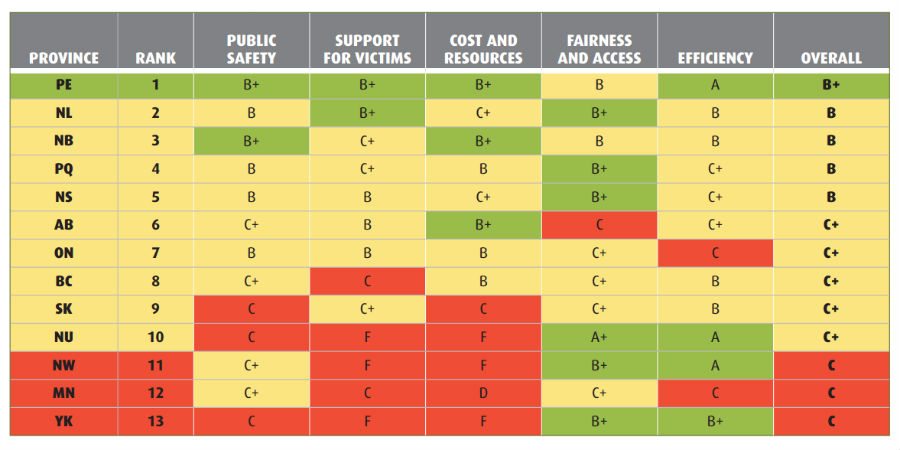
Overall, the NWT received a grade of C, which put the territory in 11th place above only Manitoba and Yukon.

Nationwide, the report suggests Canada is suffering from what it calls a ‘justice deficit’, or a large and growing gap between the aspirations of the criminal justice system and its actual performance.

The Macdonald-Laurier Institute says the purpose of the study was to enhance accountability and transparency within Canada’s justice system for the benefit of its citizens.

All told, the Atlantic provinces and Quebec generally scored better than the western provinces and territories.

Surprisingly, some larger and more prosperous provinces like Ontario and British Columbia fared poorly, receiving grades of C+.

‘Extraordinary’ per-capita violent crime rates

According to the report, the Northwest Territories has the highest number of Criminal Code incidents per police officer of any jurisdiction in Canada.

The territory also has ‘extraordinary’ per-capita violent crime rates that are second only to Nunavut, and its per-capita property crime rates eclipse every other jurisdiction in Canada.

But the territory performed particularly poorly in the categories of costs and resources and support for victims.

It’s believed that the NWT’s vast size, sparse population and significant crime rates played a role in those failing grades.

It’s not all bad news though, as the territory exceeded expectations in terms of efficiency and fairness.

In terms of access to justice, the Northwest Territories had the lowest legal aid expenditure on criminal matters per crime in the country.

Prince Edward Island outperformed all other jurisdictions, registering an overall grade of B+. Newfoundland and New Brunswick rounded out the top three.justice
Mike Gibbins
Mike Gibbins
Hello and thank you for listening to 100.1 Moose FM! To contact me, you can email me, find me on Twitter or call (867) 920-4663.

Continue Reading

You may also like


cjcd Now playing play

- Advertisement -

Related Articles

- Advertisement -

Latest News

Inuit president calling for “allyship” as Arctic security talks continue to circle

Inuit Tapiriit Kanatami President Natan Obed has called for Indigenous leaders to be included in ongoing decision-making and discussions on sovereignty and economic development in the Arctic. The call came after Indigenous leadership was reportedly left out of decision-making meetings in Ottawa last week between the premiers and the prime minister.

“Is it safe to eat vegetables from gardens in Yellowknife?”

A group of scientists working out of the territory say that while it is safe there are some “low” risks associated with growing local produce. Their project focusses on examining garden soils and vegetables, testing for arsenic and other metals associated with regional mining activity.

Two more NWT schools show elevated lead in some water taps, says GNWT

Two more schools in the territory have tested positive for elevated levels of lead in a number of their water fixtures. According to the report issued today by the GNWT, two schools in Fort Smith will undergo remediation measures for the affected water fixtures. Paul William Kaeser High School and Joseph Burr Tyrrell School in Fort Smith join a list of 12 schools, bringing the tally to 14 schools out of 18 in the N.W.T. that have tested positive for elevated lead in drinking water.

Trades Centre aims to bring modular homes to Fort Good Hope

The GNWT has partnered with Ne’rahten Development Ltd. to support the K’áhsho Got’ı̨nę Trades Centre in Fort Good Hope. 

Dene Nation stands with Alberta First Nations against separatist movement

The Dene Nation has expressed their strong support for First Nations of Alberta Treaty 6, 7, and 8, as they oppose the proposed referendum on Alberta’s sovereignty.