
Arsenic contamination from the now-defunct Giant Mine wiped out entire populations of algae and invertebrates from a lake near Yellowknife, new research has found.
A University of Ottawa study published Wednesday suggests a number of ‘key species’ living in and around Pocket Lake were severely affected by contamination from the gold mine during and after its lifetime.
And perhaps more surprisingly, many of those species – which included micro-crustacea and fly larvae – have yet to recover even after the mine’s closure.

During the 50 years that the gold mine operated, thousands of tonnes of highly toxic dust went up the roaster stack and settled on the ground and lakes around Yellowknife.
Earlier this year, the same group of Ottawa researchers found surprisingly high and even dangerous levels of arsenic and mercury in lakes within a 20-kilometer radius of the city.
That research, combined with other findings, even prompted the territory’s chief public health officer to issue an arsenic warning for a handful of Yellowknife lakes this spring.
Jules Blais teaches biology and environmental toxicology at the University of Ottawa. He also directed the most recent research effort, which began three years ago.
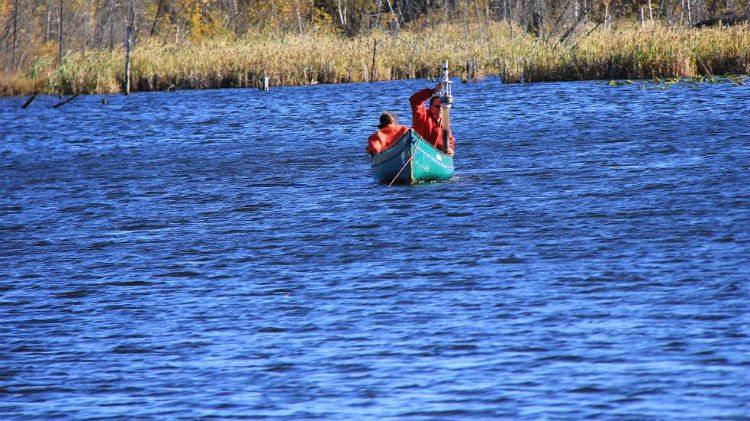
He told Moose FM research included taking sediment cores from Pocket Lake exclusively, given its proximity to Giant Mine.
“Lake sediment cores are useful because they represent the recent history of lakes,” he said. “They actually record the history of environmental change.
“We kind of consider Pocket Lake our ground zero in terms of impact on the surrounding environment because it got a maximum amount of contamination.”
Blais says researchers were able to observe arsenic, lead, mercury and other metals in deposits, but more importantly, they were able to see how the ecosystem responded to that contamination.
“The aquatic ecosystem was quite dramatically affected and one of our main findings that we found surprising was that the systems haven’t recovered yet,” he said.
“Many of these species were actually extirpated, they were eliminated and they haven’t returned yet. Part of our research now is trying to explore why.”
Blais says research into the environmental hazards of mining was scarce around the time Giant first became operational.
Part of the challenge now, he says, is applying recent research methods to better understand what happened to the environment decades ago.
Research methodology
While this study only focused on Pocket Lake – located a kilometer west of Giant’s roaster stack – Blais suspects micro-crustacea and fly larvae living in other contaminated lakes may have recovered.
That assumption could be proven in the coming months once additional lake sediment cores are analyzed.
Blais says his team has taken samples from as many as 20 surrounding lakes to see if any species have been wiped out there as well.
“We’ve published this work on Pocket Lake as an example of what was the greatest impact in the area because it’s the lake that was most influenced by the mine,” he said.
In the months to come, he wants to expand that research – studying contamination levels in other lakes and looking into whether or not other species have been negatively impacted by mining activities as well.
“These are animals that will lay their eggs in the sediment so the sediment is part of their life cycle. We are trying to figure out whether the sediments are still toxic to these species.
“We can use these results, I think, to set guidelines for emissions. We’re using this as a case study to set regulatory guidelines for mining activities in the future.”