
New research finds high levels of arsenic in Yellowknife lakes

Scientists have found surprisingly high and even dangerous levels of arsenic and mercury in a number of lakes surrounding Yellowknife.

In a study that was published Wednesday, a team from the University of Ottawa determined that some of the levels exceed guidelines for human and environmental safety.

The researchers also made the case that contaminants in the lakes are linked to industrial emissions from years past when Giant Mine was still operational.

During the 50 years that the gold mine operated, thousands of tonnes of highly toxic dust went up the roaster stack and settled on the ground and lakes around Yellowknife.
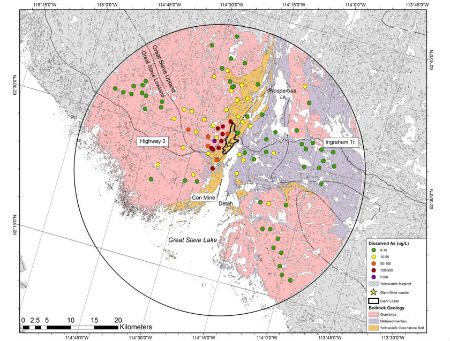
Concentrations of dissolved arsenic in surface water of lakes within a 30 km radius of Yellowknife (GNWT).

“Concentrations of arsenic are well above drinking water quality guidelines and protection of aquatic life for lakes within 17 kilometres of the Giant Mine,” said Jules Blais, who co-authored the academic paper.

Within four kilometres of the mine, arsenic levels were between three and 13 times higher than drinking water guidelines, Blais reported.

Even 17 kilometres away, about two-thirds of the sampled lakes had enough arsenic to damage aquatic life.

“This is where we would expect to see adverse effects on aquatic life,” said Blais. “There is evidence to suggest that important components of the aquatic food web are affected by arsenic in lakes around Yellowknife.”

Blais says arsenic in some of the lakes is also a human health concern and that “people who derive water from wells or lakes need to be concerned about this.”

The researchers note that none of the affected lakes are part of the watershed that supplies Yellowknife with its drinking water.

The city draws its water from the Yellowknife River, which Blais says is “mostly far removed from any industrial impact.”

The territorial government has also done research (pdf) into arsenic levels in soil and lakes in the region.

Giant Mine is currently the site of a massive federal remediation plan, with $1 billion in tax dollars earmarked to deal with the now-defunct mine.


Mike Gibbins
Mike Gibbins
Hello and thank you for listening to 100.1 Moose FM! To contact me, you can email me, find me on Twitter or call (867) 920-4663.

Continue Reading

You may also like


cjcd Now playing play

- Advertisement -

Related Articles

- Advertisement -

Latest News

Yellowknife’s latest community plan draft high on housing

On Wednesday Yellowknife city council heard more on the latest proposed community plan draft which includes incentives to help boost affordable housing as well as a new housing policy. Some councillors expressed concerns that policies could hinder development.

Hay River library services undergo changes beginning this month

The Hay River Library Committee is stepping away from their role overseeing local library services. Hay River Councillor and Deputy Mayor Keith Dohey issued the announcement on the town’s website and social media page on Thursday. Dohey said that after years of service, the committee will no longer be overseeing the library as of April 30.

Military says largest Arctic NANOOK operation to date has concluded

The Canadian Armed Forces says its largest and most comprehensive winter annual NANOOK operation yet has concluded. This year the operation exceeded its annual distance range by thousands of kilometres and took place over an extended period beginning in February. Operation NANOOK-NUNALIVUT 2026 took place from February to April 2026 and included approximately 1,300 armed forces personnel.

Parking meter rates to increase beginning May 1

The City of Yellowknife is reminding residents that the updated parking meter rates approved in December of last year will be coming into effect beginning on May 1, 2026.

Update: Norman Wells making switch from diesel to diesel

The town of Norman Wells is in the process of transitioning from diesel sourced from local oil operations to diesel run generation provided by the Northwest Territories Power Corporation.  The cost is anticipated to be greater than the current system that uses the byproduct diesel fuel.  In January, Imperial Oil Ltd. announced a plan to close their Norman Wells facility this summer after more than 100 years in operation.