NWT residents’ perception of police ‘worse than elsewhere’

Figures released on Wednesday suggest Northwest Territories residents take a dimmer-than-average view of their police.

Statistics Canada has published the results of a survey conducted in 2014, comparing the perceptions people across Canada have of their local police force.

Residents were asked to rate police work as good, average or poor in six areas. In all six, RCMP in the NWT place among the four lowest-scoring regions.

The territory fares best when residents are asked how approachable and “easy to talk to” their police are. In the NWT, Statistics Canada says 64.8 percent of those surveyed believed RCMP did “a good job”.
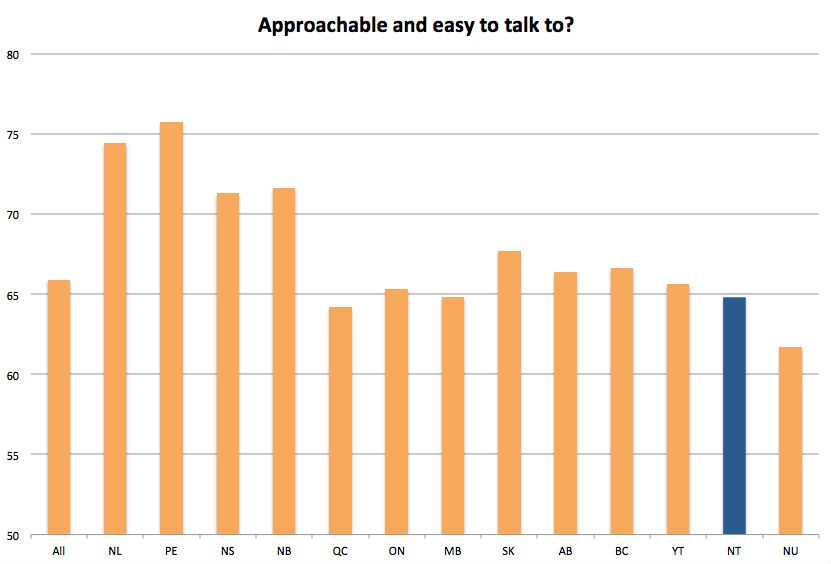
Statistics Canada data
Statistics Canada data shown: percentage of residents believing police do ‘a good job’ of being approachable and easy to talk to.

That’s the same as the figure for Manitoba, and a higher rating than achieved by forces in Quebec and Nunavut.

However, the NWT is bottom of the list when it comes to perceptions of neighbourhood safety.

Asked if police did a good job in regard to ensuring that safety, 57.1 percent of respondents in the territory said yes. That’s lower than anywhere else in Canada, including 57.4 percent in Nunavut and 59.4 percent in Yukon. The Canadian average is 66.6 percent, with a full 73 percent of Quebec residents approving of police work on neighbourhood safety.
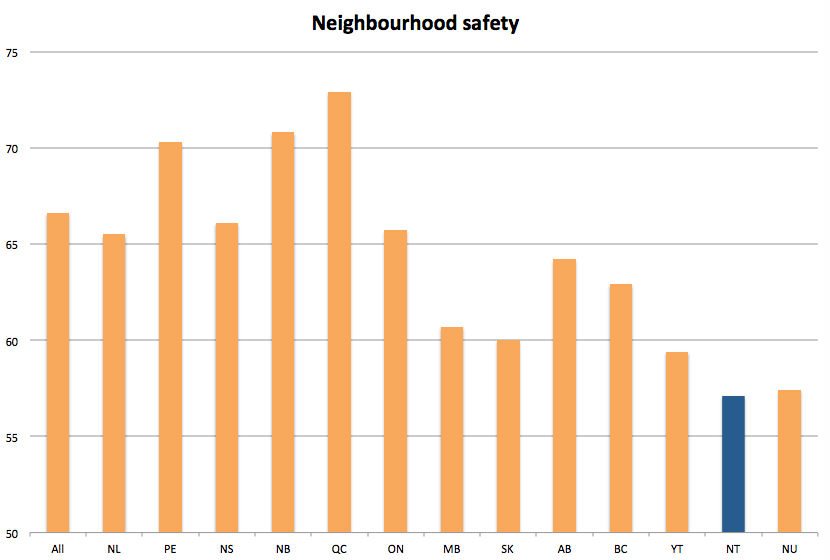
Statistics Canada data
Statistics Canada data shown: percentage of residents believing police do ‘a good job’ in regard to ensuring neighbourhood safety.

Police in the Northwest Territories are above only Nunavut when it comes to perceptions of whether people are fairly treated, whether residents feel informed about ways to prevent crime and whether police respond quickly. Only 41.5 percent of residents said RCMP did “a good job” of the latter.

The territory scores higher than Nunavut and Yukon for perceptions of the work police do in enforcing the law.

Read the survey: Full survey issued to residents in 2014

Explore the data: Results published by Statistics Canada

To come up with these figures, Statistics Canada contacted 79,000 households across the 10 provinces and a further 3,600 households in the three territories. The results published on Wednesday are a snapshot of police-related data from a much broader survey.

There was a 58.7 percent response rate in the North, meaning a total of just over 2,000 northern residents took part. Researchers spoke to one member of each household contacted. No individual figure for the NWT sample size is provided.

Ollie Williams
Ollie Williams
Hello! I'm the one with the British accent. Thanks for supporting CJCD. To contact me, you can email me, find me on Twitter or call (867) 920-4663.

Continue Reading

You may also like


cjcd Now playing play

- Advertisement -

Related Articles

- Advertisement -

Latest News

Yellowknives Dene First Nation’s Spring Carnival is almost here

Organizers said the event revitalizes the community and fosters unity within Dettah and Ndilo, as well as in Yellowknife and surrounding regions. Hundreds of people from across the region attend each year to take part in traditional and northern activities.

Yellowknife Indoor Garage Sale scheduled for May 2

Yellowknife’s Annual Indoor Garage Sale is being hosted at the Multiplex Arena located at 41 Kam Lake Rd on Saturday, May 2 from 8am to noon.  

YK city council unanimously declares March 20 half-day civic holiday

Yellowknife city council voted in favour of a half a day civic holiday for Friday March 20 in recognition of the Yellowknives Dene First Nation annual spring carnival. The city’s declaration recognizes the Dene festival that sees hundreds of people from across the region gather each year in Dettah to take part in traditional and Northern activities and celebrations.

Scientists predict Mackenzie Basin level to rise above average in spring

While data collected by the centre for climate change shows that water levels remain low in most rivers and lakes across the territory, scientists predict it will likely change for some major waterways this spring. Looking at snowpack measures, data showed that water levels are forecasted to rise above average across much of the western and southern Mackenzie River Basin.

Documentary spotlights women emerging as leaders amidst climate crisis

From the devastating 2023 wildfires that saw most of the territory and its largest city evacuated, to the Lytton wildfire in B.C. and the Fraser Valley floods, a new 2026 film focuses on women who embrace community leadership roles as mothers, artists, health professionals at the frontlines of climate disasters. “Women are disproportionately impacted by climate disasters and yet, they are not represented in terms of shaping climate policy,” said filmmaker Nova Ami.