


100.1 GO FM - We're Your Feel Good Pop Station

No kidding – surprise goat pregnancies stun Hay River farm

“They were getting a little bit fatter than we expected.”

That’s how Hay River’s Northern Farm Training Institute discovered a tiny, cute problem: surprise baby goats.

Animal manager Thomas Schenkel bought a dozen cashmere goats, prized for their wool, from a woman in British Columbia late last year.

Schenkel brought them back to Hay River completely unaware that he was actually getting more than he had bargained for: many of them were pregnant.

“After a couple of months, we realized they were unusually large,” Schenkel admitted to Moose FM.

“We realized we were going to have some unexpected babies. So we’ve been scrambling here for the last month, building extra shelters, cleaning out the hardware stores of heat lamps and anything we can find to accommodate these new arrivals.”
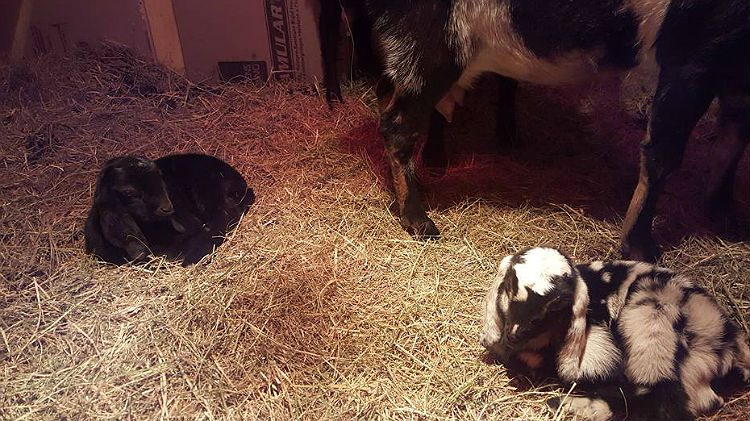
Goats
More goats. Photo: NFTI

By Monday afternoon, nine baby goats had emerged. One of the farm’s French Alpine goats added to the mix with triplets of her own, and there are also newborn Nubian goats on site.

Schenkel said more goats were due “any hour”.

“They’re actually going to be a welcome addition,” he told us. “We wanted to increase the numbers regardless.

“It’s just that dealing with newborns in January, at this latitude, is not the optimal way to bring animals into the world. But we need all the numbers we can get and so we’re happy to have them.”

Cashmere goats are prized for their wool. Schenkel says the farm also expects the goats to be good at clearing land and to produce a “good, nicely flavoured” meat.


Ollie Williams
Ollie Williams
Hello! I'm the one with the British accent. Thanks for supporting CJCD. To contact me, you can email me, find me on Twitter or call (867) 920-4663.

Continue Reading

You may also like


cjcd Now playing play

- Advertisement -

Related Articles

- Advertisement -

Latest News

Alternatives North suspects regulatory capture in ITI

Alternatives North believe they have uncovered evidence of the ‘regulatory capture’ of the GNWT Department of Industry Trade and Investment (ITI) by the mining industry, specifically regarding the regulatory policies surrounding the Mineral Resources Act. 

Relentless Indigenous Woman talks languages, “literally” changing world

Dr. Candace Manitopyes, aka The Relentless Indigenous Woman, is working with Elders and Language Keepers in the North and across Turtle Island on relaunching an Indigenous languages program. Dr. Manitopyes says there is an urgency to support Indigenous language learning, especially for Northern First Nations communities, where culturally responsive community rooted resources are even more scarce.

New generation of Indigenous languages speakers celebrated in the NWT

“The language is who we are. Language is our Elders. Language is what makes us who we are,” said Paul Andrew, who emceed a special gathering in Yellowknife that included mentors and apprentice Indigenous language learners, their families, organizers and community leaders. This year’s cohort engaged in learned the languages of Gwich’in, Tłı̨chǫ, Inuvialuktun, Inuinnaqtun, Inuktitut,Dene Kede, Dene Zhatıé, Nêhiyawêwin, Dëne Sųłıné and Wı̀ılı̀ıdeh. 

NWT services to be made accessible in Indigenous languages, says GNWT

The territorial government will soon begin offering all services in each of the 11 official languages including the nine Indigenous languages of Dinjii Zhu Ginjik (Gwich’in), ᐃᓄᒃᑎᑐᑦ (Inuktitut), Inuvialuktun, Inuinnaqtun, Dene Kǝdǝ́/ Sahtúot'ı̨nę Yatı̨ (North Slavey), Dene Zhatıé (South Slavey), Tłı̨chǫ, Dëne Sųłıné (Chipewyan) and Nëhiyawëwin (Cree). Previously, the services had been available in English and French only.

Support and funding for “Language Cafes” to launch this spring

The NWT Literacy Council has started a new funding program to help support Indigenous language revitalization. Kathryn Barry Paddock, Executive Director of the NWT Literacy Council made the announcement that the organization is promoting more funding and the creation of more accessible spaces for Indigenous language through "Language Cafe" events.


